
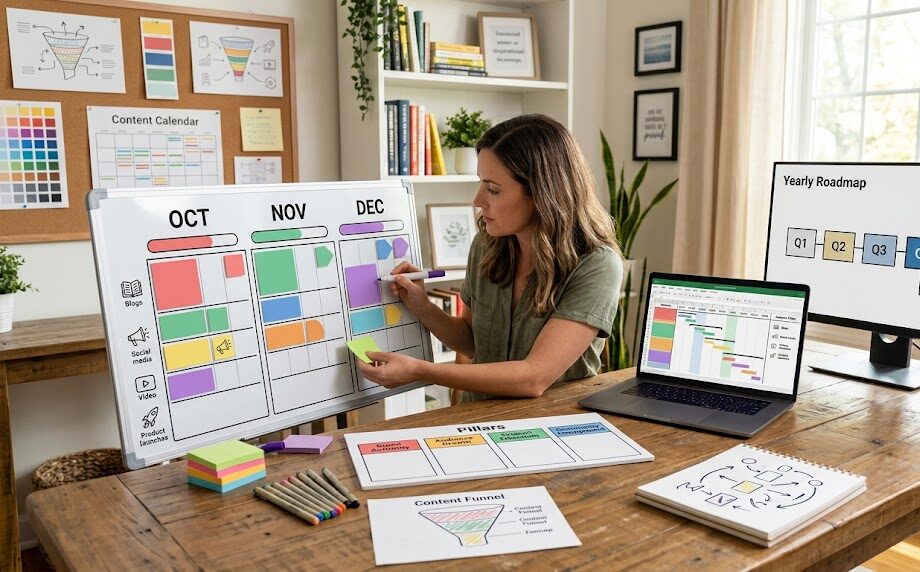

Quarterly Content Planning for Remodelers
Quarterly content planning helps remodelers stop guessing week to week and start building a steady marketing rhythm around the projects they actually want to win.
I have seen this pattern over and over with remodelers: the team has strong projects, good photos, happy clients, and plenty of practical knowledge, but the marketing happens in bursts. One week there are three posts. Then nothing. A blog gets written when someone remembers. Google Business Profile gets updated only after a slow month. That kind of stop-start marketing makes it harder to build local visibility.
A quarterly plan fixes that. It gives your content a 90-day direction: which services to push, which local markets to support, which homeowner questions to answer, which proof assets to collect, and which channels should carry the message. It keeps your marketing useful, local, and consistent without asking your remodeler team to become a full-time content department.
Why Quarterly Content Planning Matters for Remodelers
Remodeling demand is local, seasonal, and trust-driven. Homeowners do not usually wake up one morning and hire the first contractor they see. They research. They save ideas. They compare photos. They check reviews. They watch videos. They ask neighbors. They revisit your website more than once before deciding whether to call.
That is why quarterly content planning matters. It gives your brand enough time to show up repeatedly around the same valuable themes. If you want more kitchen remodels, one kitchen post will not do much. A 90-day kitchen-focused content plan can support search visibility, social proof, Google Business Profile activity, homeowner education, and sales conversations all at once.
Quarterly planning is also practical for remodelers because your business moves in cycles. You may have busy production windows, slower lead periods, seasonal exterior demand, design consultation spikes, permitting delays, and local market shifts. A 90-day content calendar gives you enough structure to plan ahead without locking you into a rigid annual plan that no longer fits by month four.
- Local visibility: Content can reinforce the services, cities, neighborhoods, and project types that matter most this quarter.
- Lead quality: Educational content helps homeowners understand fit, budget, timelines, and process before they contact you.
- Project mix: You can plan around the jobs you want more of: kitchens, baths, basements, exteriors, additions, or design-build projects.
- Operational sanity: A quarterly plan reduces last-minute scrambling for posts, articles, photos, and campaign ideas.
- Compounding growth: SEO content, social posts, GBP updates, and project proof build on each other over time.
At GYRO, this is why quarterly planning connects directly to social strategy and calendars, organic growth campaigns, and blog and resource content strategy. The plan should not live in one channel. It should connect every public signal back to the same business goal.
What Works Today in Quarterly Content Planning
The best quarterly content plans begin with business reality, not marketing fantasy. I do not like starting with “What should we post?” I prefer to start with, “What do we need the next 90 days to produce for the business?”
That question forces better decisions. If a remodeler needs more high-end kitchen projects, the plan should include kitchen planning content, layout questions, cabinet and storage education, before-and-after proof, local project examples, and a clear path to consultation. If a design-build firm needs better-fit clients, the plan should explain process, expectations, investment ranges, decision timelines, and what makes design-build different from a basic contractor bid.
Market data should also shape the plan. Harvard’s Joint Center for Housing Studies has continued to track a large national remodeling and repair market. NAHB remodeler sentiment and local building permit activity can help teams understand whether demand is strengthening, shifting, or slowing. Houzz renovation research can show what homeowners are planning, where they are spending, and which projects are getting attention. Those sources will not write your content for you, but they help you avoid planning in a vacuum.
Start With Revenue Priorities
Choose the services the business wants to grow this quarter. The content calendar should support profit, not just activity.
Use Local Signals
Review local permit activity, neighborhood development, housing age, seasonal weather, and homeowner questions from your own sales calls.
Plan Campaign Themes
Build the quarter around two or three focused themes instead of spreading attention across every service at once.
Collect Project Proof Early
Ask crews and project managers for photos, videos, notes, client comments, and before-and-after details while the work is fresh.
Map Content to Channels
Decide what belongs on the website, Google Business Profile, Instagram, Facebook, TikTok, YouTube, and email follow-up.
Review Monthly
A quarterly plan should have monthly check-ins so the team can adjust based on leads, schedule, project availability, and performance.
Quarterly planning is especially useful when paired with SEO and organic growth, Google Business Profile optimization for local leads, and Megaphone. Those systems help turn the plan into assets that can rank, convert, and keep publishing moving.
If a content idea cannot connect to a service, a local market, a homeowner question, a proof asset, or a next step, it probably does not belong in the quarter. Good content is not filler. It is a sales-support asset that works in public.
Common Quarterly Content Planning Mistakes Remodelers Should Avoid
The biggest mistake I see is treating the content calendar like a blank box that needs to be filled. That creates random posting. A quarterly plan should not be a list of disconnected ideas. It should be a focused operating plan for demand generation.
Planning Around Topics Instead of Business Goals
A topic like “bathroom trends” is not automatically useful. It becomes useful when it supports a service page, answers a real homeowner question, shows local project proof, and guides the reader toward a next step.
Trying to Push Every Service at Once
Most remodelers are better off choosing a few quarterly priorities. If every week jumps from kitchens to decks to basements to windows to additions, the market never gets a clear signal.
Ignoring Local Timing
Weather, school calendars, permitting cycles, HOA rules, older housing stock, new construction activity, and local events can all shape when homeowners start thinking about projects.
Not Building a Proof Library
Quarterly plans fail when there is no system for gathering project photos, videos, client quotes, review snippets, and field notes. The best content usually comes from work already happening inside the business.
Publishing Without Reviewing Results
A content calendar should improve over time. Review rankings, calls, forms, social engagement, Google Business Profile actions, and lead quality at least once a month.
Step-by-Step Quarterly Content Planning Process
A practical quarterly planning process should be simple enough for a busy remodeling company to use. You do not need a 40-tab spreadsheet. You need a clear strategy, a few useful inputs, and a workflow that turns the plan into published assets.
- Pick the quarter’s business goal Decide what the business needs most: more kitchen consultations, better bathroom leads, more design-build awareness, stronger local visibility, more Google reviews, or better lead nurturing.
- Choose two or three campaign themes Examples include kitchen planning season, bathroom investment decisions, basement finishing education, exterior project prep, aging-in-place improvements, or design-build process clarity.
- Review local and market inputs Look at local permit activity, housing age, neighborhood growth, homeowner questions, review themes, sales objections, and broader industry sources like JCHS, NAHB, Census permit data, and Houzz renovation research.
- Build the source asset list Plan the main articles, service-page updates, project recaps, FAQs, Google Business Profile posts, reels, social posts, and follow-up assets that support each theme.
- Assign channels and CTAs Decide where each asset belongs and what the next step should be. Not every post needs the same CTA. Some build trust, some answer questions, and some invite contact.
- Collect proof from the field Ask the team to capture before photos, progress clips, design notes, client comments, final reveals, and project lessons throughout the quarter.
- Schedule, publish, and adapt Use the quarterly plan to create weekly publishing rhythm, then adapt based on seasonality, lead flow, current projects, and what homeowners are responding to.
- Review performance monthly Track calls, forms, rankings, profile visits, Google Business Profile actions, social engagement, and lead quality. Let the data shape the next month’s emphasis.
How to Use Local Insights, Data, and Sources in the Plan
This is where remodelers can separate themselves from generic marketing. A strong quarterly plan should not sound like it could belong to any contractor in any city. It should reflect the actual market the remodeler serves.
For example, if a market has a large stock of older homes, the content should address replacement, layout modernization, aging-in-place updates, structural surprises, and realistic planning. If a city has a lot of newer subdivisions, the content may lean into personalization, basement finishing, outdoor living, storage, builder-grade upgrade projects, and design improvements. If permit activity is strong in nearby counties, there may be more opportunity to talk about additions, major renovations, and planning timelines.
Here are the planning inputs I would look at before building a quarter:
Census Permit Activity
Use local building permit data to understand construction momentum, regional growth, and where homeowners may be thinking about major improvements.
Housing Stock Age
Older neighborhoods often create different content needs than newer subdivisions. The project questions, risks, and motivations are not the same.
NAHB Remodeler Sentiment
Industry sentiment can help frame whether remodelers are seeing strong, moderate, or cautious demand in the broader market.
JCHS Remodeling Trends
National repair and improvement spending trends help remodelers understand whether the market is expanding, slowing, or shifting by category.
Houzz Renovation Behavior
Homeowner surveys can reveal which projects, priorities, and decision factors are getting attention in the renovation market.
Your Own Sales Calls
The best local source is often your own pipeline. Track the questions, objections, budgets, neighborhoods, and project types showing up in real conversations.
When GYRO builds a content plan, those inputs help us avoid generic filler. The goal is to write and publish content that sounds like it came from someone who understands remodelers, homeowners, and the local decision process.
Tools and Examples Remodelers Can Use
You do not need a complicated stack to build a quarterly plan. You need a structure your team can actually follow. The best tool is the one that keeps the plan visible and makes ownership clear.
Quarterly Campaign Map
List the quarter’s service priorities, campaign themes, local markets, target keywords, proof assets, and primary CTAs.
Content Brief Template
Standardize each asset with a topic, audience, keyword, internal links, CTA, proof source, and publishing channel.
Project Proof Folder
Store photos, videos, client notes, testimonials, before-and-after details, and project lessons by job type and location.
Google Business Profile Calendar
Plan posts, photos, service highlights, review prompts, and local updates that support the quarter’s campaign themes.
Social Repurposing Sheet
Turn one article or project recap into Instagram posts, Facebook updates, short videos, YouTube topics, and email snippets.
Monthly Performance Review
Track what content generated visibility, profile visits, calls, forms, consultations, and better-fit project conversations.
Quarterly Planning Examples for Remodelers
Here is what this can look like in the real world.
Kitchen Planning and Design Consultations
The quarter focuses on homeowners who want to plan before spring and summer construction windows. Content includes kitchen planning articles, layout FAQs, cabinet and storage tips, before-and-after reels, and Google Business Profile posts showing completed kitchen work.
Bathroom Remodel Readiness
The plan focuses on bathroom timelines, material choices, cost expectations, design decisions, and disruption planning. Social content answers common questions, while website content supports search visibility and consultation readiness.
Basement, Addition, and Whole-Home Project Education
The plan supports larger projects that require more trust and education. Content explains process, planning timelines, permitting considerations, design-build value, and what homeowners should decide before requesting a consultation.
Trust, Reviews, and Next-Year Planning
The quarter uses review generation, video testimonials, project recaps, and planning content to help homeowners get ready for next year’s projects while strengthening the remodeler’s public proof.
These examples work best when tied to website and content systems, Google Business Profile management, and local SEO for Maps and directories.
How GYRO Helps Remodelers Plan a Quarter Without Marketing Chaos
GYRO helps remodelers grow without building a large internal marketing team. Quarterly content planning is one of the clearest examples of that promise because it turns scattered marketing ideas into a practical 90-day system.
Instead of asking a remodeler to constantly decide what to write, post, film, optimize, and schedule, GYRO helps organize the quarter around service priorities, local market opportunities, search intent, project proof, social distribution, and lead paths.
GYRO combines strategist oversight with an AI-assisted content engine. That means the system can help produce SEO-aligned articles, reels, Google Business Profile posts, local pages, and social captions while a human strategist reviews tone, accuracy, positioning, and usefulness before the work goes live.
| GYRO Growth Area | How It Supports Quarterly Content Planning |
|---|---|
| Strategy Calendars | GYRO helps remodelers plan campaign themes, publishing schedules, channel roles, and monthly checkpoints across the quarter. |
| Organic Growth Campaigns | Quarterly themes become evergreen and seasonal campaigns that support visibility, trust, and qualified lead generation. |
| Megaphone | GYRO’s strategist-guided content engine helps turn keywords, project proof, and local insights into consistent publishing assets. |
| SEO and Organic Growth | Content becomes more valuable when it is mapped to search intent, local relevance, internal links, and measurable organic performance. |
Frequently Asked Questions
What is quarterly content planning?
Why should remodelers plan content quarterly?
What should a remodeler include in a quarterly content plan?
How does quarterly content planning generate better leads?
Related GYRO Resources
Plan repeatable publishing rhythms, campaign themes, and channel roles for remodeler growth.
Build evergreen and seasonal campaigns that connect content, local visibility, and lead generation.
Use GYRO’s strategist-guided content engine to produce SEO-aligned articles, reels, posts, and campaign assets.