
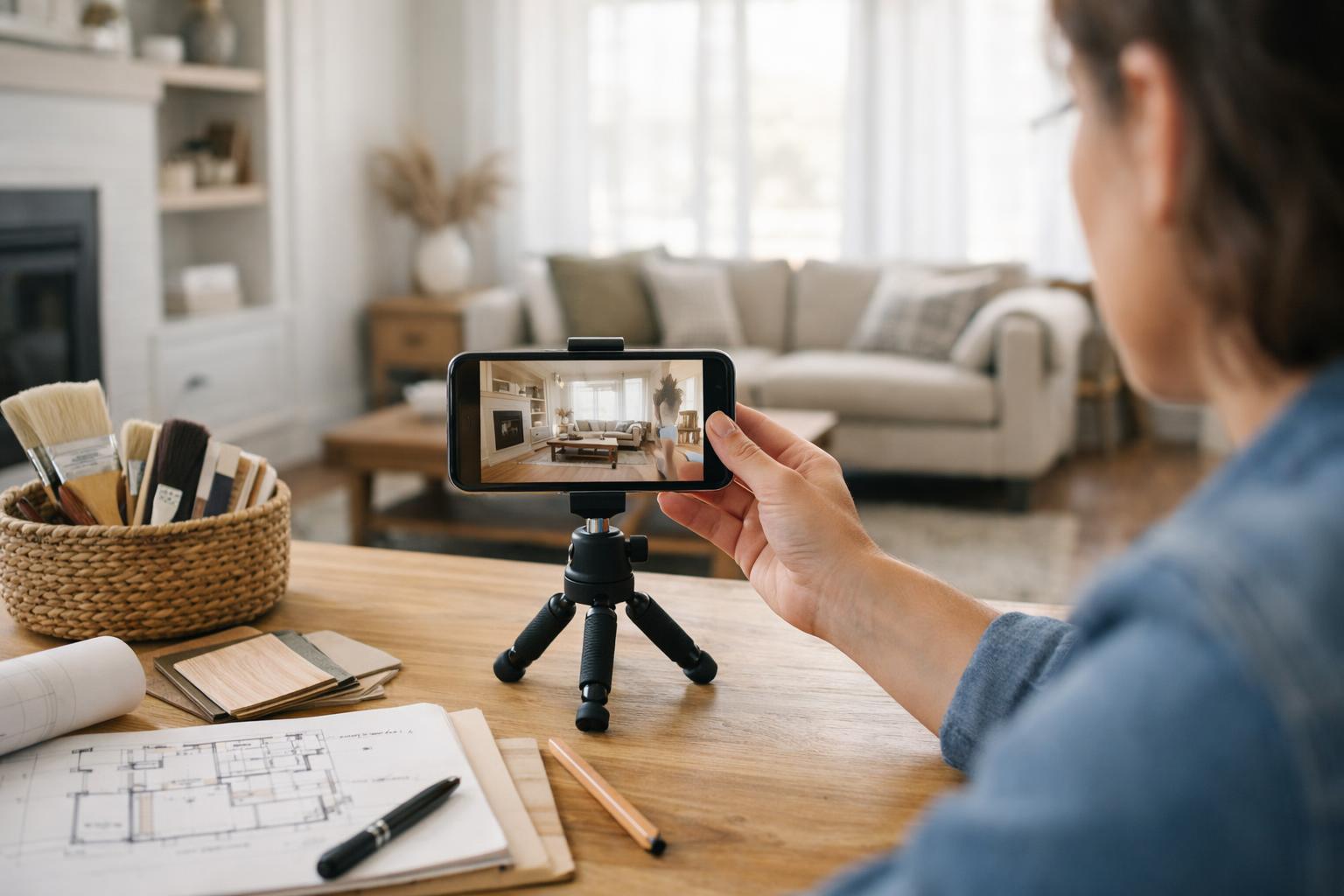
Instagram and TikTok for Remodelers and Designers Who Don’t Want to Become Influencers
Learn how short-form video can show process, proof, and trust without daily performance.
Instagram and TikTok for remodelers and designers
Are you avoiding short-form video because you have no interest in turning yourself—or your project manager—into an influencer?
Across the U.S., remodelers and interior designers do not need an influencer persona to use Instagram and TikTok well. You need repeatable videos that help a homeowner understand your process, see your judgment, notice craftsmanship, prepare for a project, and decide whether the work fits. That is trust distribution, not entertainment pressure.
Here is what I would build: one useful question, one real project setting, one clear speaker or voiceover, a few supporting shots, accurate captions, a permission check, and one sensible next step. Film in batches when the job schedule allows. Skip trends that pull attention away from the work. Measure whether the clips support better conversations, not whether the crew becomes internet-famous.
Why doesn’t short-form video require influencer behavior?
Influencer behavior is built around sustained attention on the personality. A remodeler video system can be built around sustained clarity about the work. Those are not the same job.
Your ideal homeowner does not need a dance, a trending sound, or a daily look into the owner’s life. The homeowner may need to see why a wall cannot move as easily as expected, how an occupied home is protected, what happens before cabinets are ordered, why a lighting plan has layers, or how a design team narrows material choices.
The camera is simply a distribution tool. It lets one clear explanation reach the person who was not standing beside you in the kitchen, showroom, or jobsite. When the answer is useful, the video can build familiarity before the sales call. When the answer is vague, overproduced, or disconnected from the project, more reach does not fix it.
This is why I start with the operating question: What can your team explain accurately and repeat without disrupting production? A superintendent may be comfortable narrating a protection setup but not appearing on camera. A designer may prefer a voiceover over material samples. An owner may be strongest answering project-fit questions from the office. Build around those strengths.
Your Instagram and TikTok system should fit the outfit. It should not ask a capable remodeler to copy a creator whose business model depends on constant content. The remodeler’s business model depends on right-fit projects, sound production, and a job schedule that holds together.
Straight talk: you do not need to perform more. You need to document better. One useful explanation from a real project can do more trust-building work than a polished clip that says nothing.
Which remodeling and design videos do homeowners actually need?
Start with the questions that already appear in estimates, design meetings, showroom conversations, and project emails. Those questions are better raw material than a trend calendar because they come from the homeowner questions you already hear.
Explain the room, not just the reveal
Show the original constraint, broad scope, one major decision, and the finished relationship among circulation, storage, lighting, or material choices.
Show why a detail matters
Use an accurate explanation of alignment, waterproofing logic, transitions, protection, sequencing, or another detail the team can verify. Do not pretend Bradd or the marketer performed the trade work.
Answer the question before the call
Explain service area, project type, design responsibility, consultation preparation, occupied-home planning, or another factual question that regularly slows down qualification.
Make the invisible stage visible
Show discovery, measuring, selections, estimating, preconstruction, site protection, trade coordination, or closeout only where those stages match the outfit’s real process.
Connect taste to a decision
Explain material relationships, lighting, circulation, storage, proportion, or a selection tradeoff without turning the video into a shopping haul or revealing private client information.
Help the wrong job self-select out
Clarify the kinds of projects the outfit handles, the service boundary, the design model, and what a prospect should prepare before the next step.
Do not make every clip a sales pitch. A useful video can answer a question and stop. The next step can be quiet: read the fuller project story, review the service, save the explanation, or bring the question to a consultation.
Keep claims tied to what is visible or documented. A close-up of a cabinet reveal can support an explanation of alignment. It does not prove that every project is flawless. A clean protection setup can show one project’s process. It does not justify “every project stays spotless from start to finish” unless the outfit has evidence for that broad statement.
What simple formats can your team film on-site or in the studio?
A repeatable format removes decisions. The team does not have to invent a concept, script a performance, and learn a new edit every week. It fills the same frame with a different real question.
| Format | What to capture | What it helps prove | What to avoid |
|---|---|---|---|
| One question, one answer | A direct answer from the owner, designer, estimator, or project lead with the relevant room or plans in view. | Clarity, expertise, and project-fit expectations. | A pile of unrelated tips, unsupported absolutes, or a long company introduction. |
| Three-shot voiceover | One wide shot, one process shot, and one detail while a calm voiceover explains the decision. | How the visible evidence connects to scope or process. | Random montage footage that does not match the narration. |
| Before, constraint, after | The original condition, the issue that shaped the work, and the completed condition. | Problem-solving without needing a dramatic performance. | Claiming a result the images cannot support or exposing private details. |
| Detail with context | A close view of one material, transition, layout line, or construction detail plus a wider context shot. | Why the detail matters to function, durability, or design. | Trade jargon with no homeowner explanation or unverified technical advice. |
| Plan-to-room comparison | A permission-cleared plan or sketch paired with the built space. | Design intent, circulation, storage, or spatial relationships. | Readable client information, addresses, costs, or proprietary documents. |
| Project-fit answer | A concise explanation of the service, project type, service area, or consultation step. | Whether the viewer should continue toward a call. | Invented pricing, universal timelines, or promises that vary by jurisdiction and scope. |
Use a small capture card for each video:
- One homeowner question.
- One approved location.
- One speaker or voiceover owner.
- Three supporting shots.
- One verified takeaway.
- Caption and terminology review.
- Permission status.
- One next step.
This can fit on a project checklist or content board. It is easier to delegate than “get more video.” The field team knows what evidence to capture, and the person editing knows the point of the clip.
A sustainable social media system for remodelers also needs a stop rule. If the job is at a sensitive stage, the homeowner has not approved filming, the explanation is not technically verified, or the crew is under pressure, skip the capture. Production comes first.
How can designers show process and taste without overproducing?
Interior designers and residential architects often have a different concern: the work is visual, but a highly produced feed can flatten the thinking into a style board. The better opportunity is to show how taste becomes a decision.
Explain relationships instead of declaring trends. Why does the warm wood work with the stone? How did circulation affect the island? What did the lighting need to do at different times of day? Why was one storage option rejected? Which existing condition shaped the plan? Those answers show judgment without claiming that one aesthetic is universally correct.
Use project photography as evidence, but do not let it become the whole message. A designer can narrate a plan, mark up a permission-cleared image, compare two material relationships, or walk through a finished room and explain the sequence of attention. The viewer should leave understanding a decision, not only admiring a room.
For a firm serving creative clients, connect the video system to the broader interior designer marketing approach. The website, project story, social clips, proposal, and consultation should describe the same audience, project types, design process, and proof.
Do not overproduce before the format is proven sustainable. Natural light, a steady phone, clean audio, accurate captions, and a clear explanation are enough to test the system. Add production layers only when they help the homeowner understand the work.
How do you film, caption, approve, and schedule without disrupting the job?
The workflow should fit between real responsibilities. If the system requires the owner to stop at every site, write a script, reset a room, and edit late at night, it will disappear as soon as backlog or production pressure rises.
Choose the question before the camera comes out
Pull the topic from a real project note, homeowner FAQ, selection issue, or sales-call question. Confirm who can answer it and what evidence supports the answer.
Film the explanation and support shots separately
Record a clean answer or voiceover, then collect a wide shot, a process shot, and a detail. Avoid filming private documents, addresses, faces, or neighboring homes without approval.
Check facts, permission, captions, and the next step
Have the person responsible for the project verify trade terms, product names, claims, and client privacy. Correct auto-generated captions before posting.
Batch the approved clips around capacity
Use a strategy calendar to balance project proof, process, education, and fit. Do not create a daily quota that competes with production.
Save the clean source files and project facts
Keep the original clip, caption, permission status, project category, service area, and website destination together so the asset can be reused accurately.
Record the questions the clip creates
Use comments, calls, emails, and consultations to find the next useful answer. Do not let comments become public project advice beyond what the team can verify.
TikTok supports auto-generated captions that can be edited or removed after posting. Treat that as a starting point, not a final transcript. Remodeler language is easy to mishear: product lines, material names, trade terms, and local place names need a human check.
Choose a cadence after you know the available assets and approval capacity. No official source requires a remodeler to post daily or publish a fixed number of clips. One focused filming session that produces several accurate videos may be more sustainable than constant on-site interruption.
Source basis: Instagram Reels and TikTok are current short-form environments, but neither requires an influencer persona. TikTok’s accessibility guidance confirms that auto-generated captions can be edited. Google’s video guidance requires a qualifying, indexed watch page with prominent video and a stable thumbnail when video-search visibility is the goal. A social upload or casual embed is not automatically a video result.
When should you skip a trend?
A trend is not automatically bad. It becomes a problem when the format asks you to trade clarity, accuracy, privacy, or brand fit for a burst of attention. Before using one, ask whether the right homeowner will understand the project better after watching it.
I would skip a trend when the joke depends on making the client, trade partner, employee, or competitor look foolish; when the audio or caption changes the meaning of the work; when the team has to stage a process that did not happen; or when the format pushes an unsupported claim about cost, timing, durability, code, permits, or results.
Skip it when the trend is already consuming more production time than the explanation is worth. A remodeling company can spend an hour resetting a room, coordinating people, and editing transitions for a clip that attracts viewers who will never fit the service area or project scope. That is not a content system. It is a second job.
Also skip the trend when it creates a version of the brand the sales team cannot carry into the next conversation. A calm, design-led firm does not need a frantic feed. A premium design-build outfit does not need to mock budget-conscious homeowners. A technical trade does not need to give simplified advice beyond what the team can verify.
Use a trend only when it provides a useful container for a real answer. Keep the project evidence central, remove anything that feels forced, and make sure the clip still works after the trend passes. Evergreen proof has a longer shelf life than a joke tied to one week of platform culture.
When you are unsure, save the footage and publish the straightforward version first. You can always test a different edit later. You cannot easily undo a privacy mistake, a misleading claim, or a clip that makes the outfit look less disciplined than the work. The brand has to survive the edit every single time.
Where can one useful clip be repurposed beyond Instagram or TikTok?
A useful answer should not live only in a feed. Save the clean source clip and ask where the same explanation helps the homeowner decision process.
A project walkthrough can support the full project story. A process answer can sit beside the relevant section of a service page. A selection explanation can become part of an email or planning article. A project-fit answer can help the sales team prepare a prospect before the call. A craftsmanship clip can support a proposal when it accurately matches the proposed scope.
Repurposing does not mean dropping the same vertical embed into every page. The website context matters. Add a text summary, a descriptive title, and the surrounding proof the visitor needs. When the business wants a video to be eligible for video search, Google’s requirements for a dedicated watch page, prominent placement, crawl access, and a stable thumbnail become a separate technical project.
Use the broader organic campaign system to connect one clip to related assets: a case study, a service-page proof block, a photo carousel, an email note, and a sales-use excerpt. The project stays the source. The channel changes the packaging.
Keep permissions attached to every reuse. Approval for an Instagram post may not mean approval for a website case study, proposal, ad, or email. Confirm the scope before moving the footage.
The no-influencer content rule
Film what the right homeowner needs to understand. Support it with real project evidence. Caption it accurately. Put it where it helps the next decision. Skip everything that exists only to make the outfit look busy online.
What should you measure besides views and likes?
Views and likes are attention signals. They do not tell you whether the person lives in the service area, wants the right project type, understands the scope, or is ready for a consultation.
Use the outfit’s own systems to track business signals where possible:
- Website visits or page actions tied to the clip.
- Calls, forms, or messages that identify the social source.
- The project type and service area requested.
- Whether a prospect mentions a specific video during the sales call.
- Whether the inquiry becomes a qualified consult, proposal, or another disposition.
- Which video questions are saved, shared, or repeated in real conversations.
- How much capture, review, and editing time the system consumes.
Do not assign revenue to a clip without a documented path. Do not call a high-view video successful when it attracts the wrong project. The useful question is whether the video system helps right-fit people understand the outfit without creating another full-time job.
Frequently asked questions
Do remodelers need to show their face in every Instagram Reel or TikTok?
No. Use a voiceover, hands demonstrating a detail, a project walkthrough, plans, samples, or another approved format. Show a person when it strengthens trust and the person is comfortable—not because the platform requires it.
How often should a remodeling company post short-form video?
There is no universal cadence. Choose a schedule based on useful topics, permission-cleared assets, approval capacity, and the job schedule. Consistent quality is more important than a daily quota.
What can I film when the homeowner does not want the project shown?
Respect the boundary. Use permission-cleared showroom materials, anonymized educational explanations, office or shop demonstrations, illustrations, or another project whose use is approved. Do not reveal the address, plans, family, or room without permission.
Can I use the same vertical video on Instagram, TikTok, Facebook, and my website?
You can reuse the source clip when permissions allow, but review the caption, crop, platform features, website context, and next step. A social clip embedded on a page is not automatically eligible for Google video results.
Do captions matter for remodeling videos?
Captions make spoken information available when audio is off and can improve access, but they must be checked. Edit auto-generated text for trade terms, product names, measurements, place names, and any wording that could change the claim.
What should I track if likes and follower count are not the main goal?
Track website actions, inquiry source, requested project type, service-area fit, consultation quality, repeated questions, sales references, and production time where your systems allow. Use your own data rather than a generic benchmark.
Build a system your team will still use next quarter
Could your team film useful project proof without turning anyone into an influencer?
Send two recent permission-cleared project galleries and your current social-channel links. I’ll show you the repeatable filming, approval, caption, scheduling, and repurposing formats I would build for a U.S. remodeling or design outfit. No pitch—just a real look at what your team can sustain.