
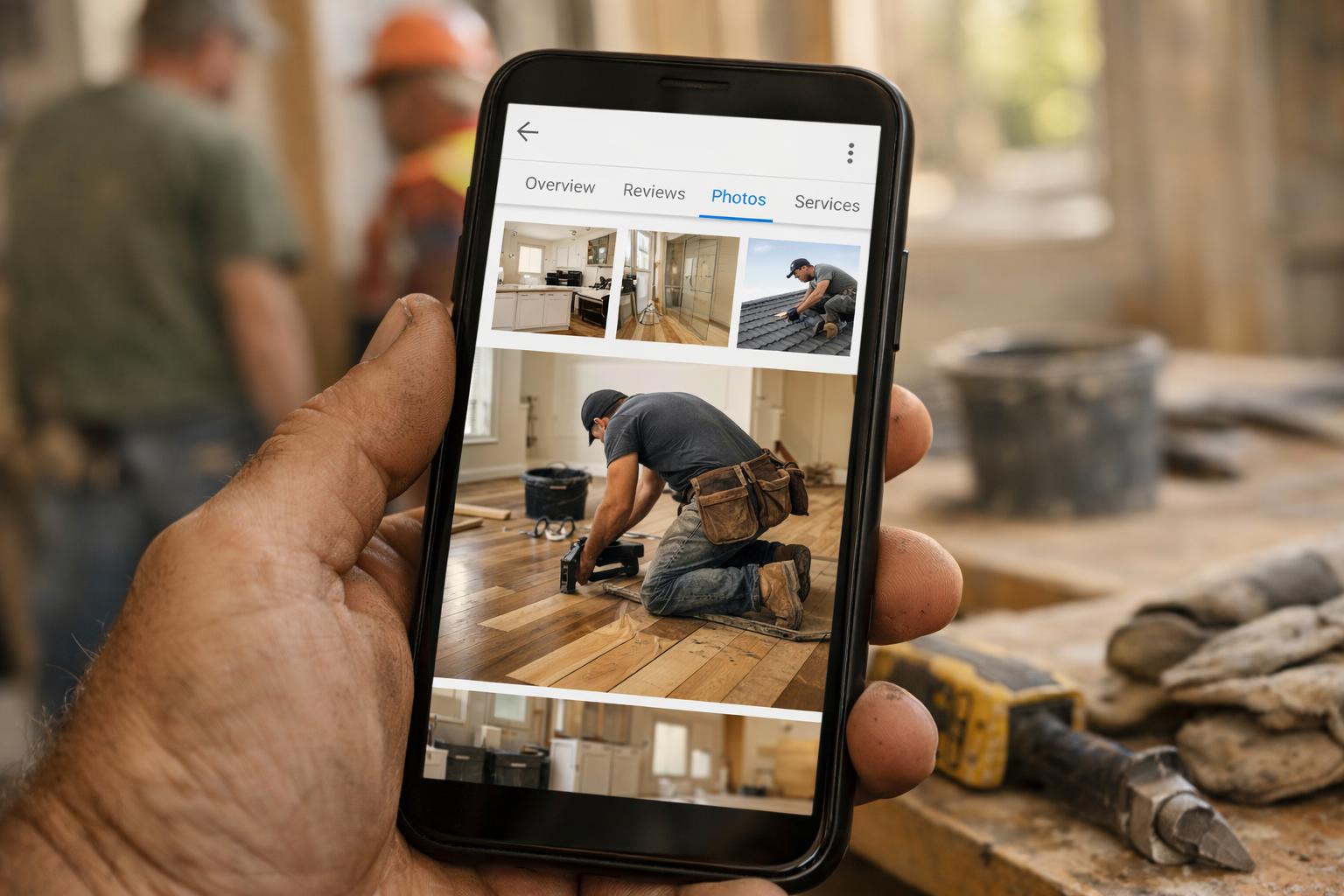
Google Business Profile Photos: What Actually Gets Clicked
Learn what types of Google Business Profile photos actually drive clicks and calls for remodeling companies, beyond generic project photos.
Straight talk for working outfits
Google does not publish a universal list of remodeling photos that will always earn clicks. Across the U.S., I would build a truthful set that helps a homeowner identify the business, understand the project types, see real work in progress, inspect finished details, and meet the people behind the outfit—then use the profile and pipeline data to learn what supports action.
Google lets verified Business Profiles add photos and videos and says business-specific photos can help customers understand the business. Google also notes that choosing a cover photo does not guarantee it will appear as the first image.
That is the verified framework. It is not a promise about ranking, reach, leads, conversion, revenue, timing, project mix, or return. The rest of this guide shows how I would turn that framework into a practical operating decision for one remodeling or design business.
What matters first
The short version
- No photo type guarantees clicks, calls, or ranking.
- Show the business, process, people, and projects truthfully.
- Capture the project story throughout the job instead of relying on one final image.
- Review profile activity and lead conversations before declaring a photo format successful.
Why a generic finished-room gallery is incomplete
Straight answer: A polished room shows outcome but may not show the outfit, service, scope, constraints, process, or whether the project resembles the homeowner’s plan.
I separate the source of truth from the working hypothesis. A platform policy, account setting, business record, original project file, or first-party lead note can support a decision. A vendor claim, industry slogan, or competitor screenshot may raise a question, but it does not prove what will work for your outfit. For Google Business Profile photos for remodelers, that keeps the plan tied to evidence instead of a confident assumption.
This is the same discipline you use on a scope. Existing conditions come first, then constraints, sequence, owner, dependency, and inspection. Marketing work gets expensive when every idea becomes a change order because the operating assumptions were never written down.
Keep the review close to the work. Save the source link, screen or export the starting condition, date the change, and note the next checkpoint. When several changes land at once, be honest about attribution. The record should help you make the next decision, not manufacture a success story after the fact.
Before you move on, write down the next decision in one sentence. Name what you know, what you still need, who owns the work, and what record will show whether it happened. That short line turns a broad marketing idea into something your outfit can actually schedule, review, and improve.
Identity
Exterior, vehicle, signage, or team context where accurate and permitted.
Check: Helps a customer recognize the real business.
Process
Protection, planning, progress, craftsmanship, and problem-solving context.
Check: Shows how the work is approached.
Result
Representative finished rooms and details with truthful project context.
Check: Shows the type and quality of completed work.
Which photo categories support a homeowner decision
Straight answer: Use accurate exterior or identity images where relevant, crew and process images with permission, in-progress details, before-and-after context, and finished work.
The practical test is ownership. Someone has to collect the input, approve the change, publish or implement it, respond when a homeowner acts, and record what happened next. If the plan cannot name those owners, it will compete with estimates, production meetings, change orders, and the job schedule until it disappears. For Google Business Profile photos for remodelers, that keeps the plan tied to evidence instead of a confident assumption.
A strong system should survive a busy week. The crew should know what to capture, the office should know what to send, the owner should know what to approve, and the lead record should show whether the next call fits. That is more valuable than a calendar nobody can maintain.
The owner still has to protect capacity. A channel that creates more low-fit conversations can add office work without adding the project mix you want. Classify inquiries by service, geography, scope, readiness, and disposition so attention is compared with the actual work the outfit can schedule.
Before you move on, write down the next decision in one sentence. Name what you know, what you still need, who owns the work, and what record will show whether it happened. That short line turns a broad marketing idea into something your outfit can actually schedule, review, and improve.
Source basis
This guide uses Google: Manage Business Profile photos and videos, Google: Tips for business-specific photos, Google: Edit your Business Profile, Google: Tips to improve local ranking, GYRO: Optimization for Local Leads. Those sources support the platform rules, first-party service context, and process boundaries stated here. They do not guarantee a ranking, click, lead, consultation, project, conversion rate, timeline, or return.
What truthful presentation requires
Straight answer: Use recent, representative media; protect privacy; keep location and project claims accurate; and avoid imagery that implies work the outfit did not perform.
Use real numbers only when they come from your accounts and your business. Platform views, website actions, calls, consultations, bids, wins, losses, project types, service areas, and schedule fit answer different questions. I will not turn one activity metric into a promised lead or project. For Google Business Profile photos for remodelers, that keeps the plan tied to evidence instead of a confident assumption.
Do not confuse polish with proof. A good-looking page or post may earn attention, but the homeowner still needs to understand the project, process, fit, and next step. Your pipeline then has to show whether that attention turned into a conversation worth the estimator’s time.
Write the approval boundary before production starts. Decide which business claims need the owner, which project facts need the project manager, which images need client permission, and which platform rule needs a fresh check. That keeps a fast publishing workflow from creating a slow cleanup problem later.
Before you move on, write down the next decision in one sentence. Name what you know, what you still need, who owns the work, and what record will show whether it happened. That short line turns a broad marketing idea into something your outfit can actually schedule, review, and improve.
Identity
Exterior, vehicle, signage, or team context where accurate and permitted.
Process
Protection, planning, progress, craftsmanship, and problem-solving context.
Result
Representative finished rooms and details with truthful project context.
How to build the job-site capture routine
Straight answer: Put shots into the project checklist at existing conditions, protection, rough work, key decisions, progress, detail, punch, and clean completion.
Build the next move around the bottleneck. If the issue is accuracy, fix the business facts. If the issue is proof, improve project documentation. If the issue is follow-up, repair the handoff. If the issue is measurement, connect the channel to the pipeline before buying more activity. For Google Business Profile photos for remodelers, that keeps the plan tied to evidence instead of a confident assumption.
One focused quarter is enough to learn about the workflow, not enough to guarantee an outcome. Set the starting condition, make the planned changes, keep the evidence clean, and review what moved. Then keep, stop, or change the work without rewriting history.
A useful monthly review should end with an operating choice. Keep the part that is reliable, stop the part that has no clear job, and change one part that is blocking the next handoff. Record why. Without that decision, reporting becomes a stack of numbers that never reaches the crew or pipeline.
Before you move on, write down the next decision in one sentence. Name what you know, what you still need, who owns the work, and what record will show whether it happened. That short line turns a broad marketing idea into something your outfit can actually schedule, review, and improve.
- Write the shot listTie every requested image to a homeowner question or proof need.
- Assign the capture ownerPut responsibility on the project workflow, not on memory.
- Protect consent and privacyRecord permission and remove sensitive client or location details.
- Upload with contextChoose accurate project and service language without keyword stuffing.
- Review the handoffLook at profile activity, site behavior, and actual lead conversations.
What to check before the next upload
Straight answer: Verify ownership and permission, crop, brightness, orientation, file quality, project context, duplicate status, and whether the image helps a homeowner decide.
I separate the source of truth from the working hypothesis. A platform policy, account setting, business record, original project file, or first-party lead note can support a decision. A vendor claim, industry slogan, or competitor screenshot may raise a question, but it does not prove what will work for your outfit. For Google Business Profile photos for remodelers, that keeps the plan tied to evidence instead of a confident assumption.
This is the same discipline you use on a scope. Existing conditions come first, then constraints, sequence, owner, dependency, and inspection. Marketing work gets expensive when every idea becomes a change order because the operating assumptions were never written down.
Keep the review close to the work. Save the source link, screen or export the starting condition, date the change, and note the next checkpoint. When several changes land at once, be honest about attribution. The record should help you make the next decision, not manufacture a success story after the fact.
Before you move on, write down the next decision in one sentence. Name what you know, what you still need, who owns the work, and what record will show whether it happened. That short line turns a broad marketing idea into something your outfit can actually schedule, review, and improve.
- Which claim is supported by a current official or first-party source?
- Which number comes from your own account or pipeline?
- Which part depends on a person, permission, policy, or project detail?
- Which outcome is still unknown and should remain unknown?
Why the cover image is not fully controlled
Straight answer: Google says a selected cover photo is not guaranteed to appear first, so the entire visible library should represent the business responsibly.
The practical test is ownership. Someone has to collect the input, approve the change, publish or implement it, respond when a homeowner acts, and record what happened next. If the plan cannot name those owners, it will compete with estimates, production meetings, change orders, and the job schedule until it disappears. For Google Business Profile photos for remodelers, that keeps the plan tied to evidence instead of a confident assumption.
A strong system should survive a busy week. The crew should know what to capture, the office should know what to send, the owner should know what to approve, and the lead record should show whether the next call fits. That is more valuable than a calendar nobody can maintain.
The owner still has to protect capacity. A channel that creates more low-fit conversations can add office work without adding the project mix you want. Classify inquiries by service, geography, scope, readiness, and disposition so attention is compared with the actual work the outfit can schedule.
Before you move on, write down the next decision in one sentence. Name what you know, what you still need, who owns the work, and what record will show whether it happened. That short line turns a broad marketing idea into something your outfit can actually schedule, review, and improve.
A finished kitchen gets attention. The sequence that shows the old constraint, the protection plan, the cabinet decision, the in-progress detail, and the clean result gives the homeowner a reason to understand the outfit—not just admire the room.
How to test photo usefulness without inventing causation
Straight answer: Note upload dates and themes, review first-party profile activity, inspect website and call context, and avoid claiming one image caused a lead.
Use real numbers only when they come from your accounts and your business. Platform views, website actions, calls, consultations, bids, wins, losses, project types, service areas, and schedule fit answer different questions. I will not turn one activity metric into a promised lead or project. For Google Business Profile photos for remodelers, that keeps the plan tied to evidence instead of a confident assumption.
Do not confuse polish with proof. A good-looking page or post may earn attention, but the homeowner still needs to understand the project, process, fit, and next step. Your pipeline then has to show whether that attention turned into a conversation worth the estimator’s time.
Write the approval boundary before production starts. Decide which business claims need the owner, which project facts need the project manager, which images need client permission, and which platform rule needs a fresh check. That keeps a fast publishing workflow from creating a slow cleanup problem later.
Before you move on, write down the next decision in one sentence. Name what you know, what you still need, who owns the work, and what record will show whether it happened. That short line turns a broad marketing idea into something your outfit can actually schedule, review, and improve.
Keep
Work that can be sourced, assigned, completed, measured, and connected to the right project conversation.
Stop
Activity that exists only to fill a calendar, repeat a vanity metric, or imitate a competitor without business evidence.
Change
The smallest controllable part of the workflow that currently blocks accuracy, proof, response, or measurement.
What a practical photo strategy looks like
Straight answer: Define project priorities, shot list, capture owner, transfer location, permission record, approval, upload cadence, archive, and monthly review.
Build the next move around the bottleneck. If the issue is accuracy, fix the business facts. If the issue is proof, improve project documentation. If the issue is follow-up, repair the handoff. If the issue is measurement, connect the channel to the pipeline before buying more activity. For Google Business Profile photos for remodelers, that keeps the plan tied to evidence instead of a confident assumption.
One focused quarter is enough to learn about the workflow, not enough to guarantee an outcome. Set the starting condition, make the planned changes, keep the evidence clean, and review what moved. Then keep, stop, or change the work without rewriting history.
A useful monthly review should end with an operating choice. Keep the part that is reliable, stop the part that has no clear job, and change one part that is blocking the next handoff. Record why. Without that decision, reporting becomes a stack of numbers that never reaches the crew or pipeline.
Before you move on, write down the next decision in one sentence. Name what you know, what you still need, who owns the work, and what record will show whether it happened. That short line turns a broad marketing idea into something your outfit can actually schedule, review, and improve.
Use the page that matches your next decision
GBP Optimization for Local Leads
Review the service or audience context tied to this guide.
Open the topic pageScopeHow I help remodeling outfits
See the available work without forcing every service into one plan.
Review the optionsContactSend the operating details first
Share the website, project mix, market, and part of the pipeline that feels off.
Use the contact pageFrequently asked questions about Google Business Profile photos for remodelers
Which GBP photo should a remodeler upload first?
Start with accurate business identity and representative service proof, then build a balanced library. Use current platform guidance and your own first-party records before treating the answer as a forecast for your outfit.
Can I force Google to show my cover photo first?
No. Google says selecting a cover photo does not guarantee it will appear first. Use current platform guidance and your own first-party records before treating the answer as a forecast for your outfit.
Do before-and-after photos guarantee more calls?
No. They can clarify change, but clicks and calls depend on many factors and should be measured. Use current platform guidance and your own first-party records before treating the answer as a forecast for your outfit.
Should client faces or addresses appear?
Use documented permission and protect privacy; avoid sensitive details that are not necessary. Use current platform guidance and your own first-party records before treating the answer as a forecast for your outfit.
How often should photos be added?
Use a sustainable cadence tied to real projects and quality control; no universal number guarantees performance. Use current platform guidance and your own first-party records before treating the answer as a forecast for your outfit.
How do I know which photos help?
Use first-party activity and lead context as clues, while avoiding unsupported one-image causation claims. Use current platform guidance and your own first-party records before treating the answer as a forecast for your outfit.
A real look at your situation
Wondering what your marketing is actually missing?
Bring the website, Google Business Profile photos for remodelers, your priority project types, service area, and the part of the pipeline that feels off. I will tell you what I would inspect first. No pressure. No hard pitch.
No pressure. No hard pitch. Just smart ideas for your business.
Bradd Hogan
I build practical marketing systems for remodeling and design outfits. I start with the operating facts, connect the work to the pipeline, and tell you what I would do next without promising an outcome I cannot control.