
Solid Rock Construction Marketing Audit
A practical outside-in review of Solid Rock Construction’s basement-focused website, local search presence, trust proof, content opportunities, and estimate path.
TL;DR
Solid Rock already has the thing most remodelers are trying to manufacture: a clear niche. The next move is to turn that niche into a cleaner, more measurable system that helps the right homeowners trust you faster.
Basement focus is clear.
Your website is not vague about what you do. Colorado Springs basement finishing and remodeling is the center of the offer, with full basements, bedrooms, bathrooms, wet bars, kitchenettes, and custom spaces all visible.
The homepage carries too much weight.
The homepage has strong raw material, but too many service, proof, FAQ, gallery, and conversion jobs are happening in one place. That creates comparison friction for high-intent homeowners.
Package proof into pages.
Dedicated service pages, process content, and project case studies would make the existing proof easier to find, easier to trust, and easier to turn into right-fit estimate requests.
Make the estimate path more resilient.
During the review, the callback area showed a JavaScript requirement. That should be tested on live mobile, backed up with a fallback path, and connected to call and form tracking.
Clean up entity consistency.
Public signals are credible, but they appear fragmented across Solid Rock Construction, Solid Rock Basements, and related Custom Homes references. Search engines and homeowners both benefit when those signals agree.
Measure, clarify, build.
Start with tracking, form testing, and citation cleanup. Then build service pages, case studies, a process page, and a review/project repurposing workflow before spending harder on paid traffic.
What Solid Rock Already Has Going For It
The useful story is already there. Solid Rock does not need a manufactured marketing angle. It needs clearer packaging around the proof it already has.
The niche is real.
Solid Rock’s website presents the business as a Colorado Springs basement finisher and remodeler, not a general contractor trying to sound relevant to every possible project. That matters. Basement buyers have specific concerns around moisture, HVAC, egress, plumbing, inspections, timeline, and whether the finished lower level will feel like the rest of the home.
When a business is already this clear about its specialty, the marketing job becomes more focused: show the process, show the projects, answer the hard questions, and make the estimate path easy to trust.
Years of experience claimed
The website uses this as a major proof point. It should be tied to project stories and process details.
Basements finished or remodeled
This is strong category proof. It deserves more visual support through case studies.
Service-area focus
The website says Solid Rock serves customers within 30 miles of Colorado Springs.
Public trust signal
A public BBB profile and local contractor listing create useful third-party corroboration, with details to keep consistent.
FAQ depth is better than average.
The homepage answers real basement questions: cost, timeline, permits, egress, moisture, insulation, HVAC, lighting, plumbing, budgeting, and financing. That content should become a structured content engine.
The gallery has useful range.
Custom basement spaces, bathrooms, bars, kitchenettes, theaters, fireplaces, and entertainment areas are represented. The missing piece is not the visual proof; it is the story around each project.
Testimonials hit the right themes.
Customer quotes speak to quality, integrity, professionalism, promptness, and a first-class process. Those are exactly the fears a homeowner is trying to resolve before inviting a contractor into the home.
Market Position and Customer Fit
The strongest market position for Solid Rock is not “we do everything.” It is “we know Colorado Springs basements, and we know how to finish them without making the process harder than it needs to be.”
Current position
Solid Rock is already positioned around basement finishing and remodeling in Colorado Springs. The service mix supports that position: full basement finishing, basement bedrooms, basement bathrooms, wet bars, kitchenettes, and custom ideas like theaters, saunas, wine cellars, and golf simulator spaces.
The likely best-fit customer is a homeowner with an unfinished or outdated lower level who wants more living space, a guest suite, entertainment space, work-from-home space, or a more valuable home. Colorado Springs also has a meaningful owner-occupied housing base, which supports a local homeowner audience for this kind of work.
Customer concerns to speak to directly
- Will the finished basement match the rest of the house?
- Will the project pass inspections and meet local requirements?
- Will moisture, ventilation, plumbing, or egress create problems later?
- Will the project stay on schedule without the homeowner managing every trade?
- What will change the price, and what should be decided before work starts?
What this means in plain English
Solid Rock does not need to compete as another broad remodeler. The business has a better lane: basement-specific expertise, local experience, process clarity, and finished-project proof. That lane should shape the website, service pages, review requests, Google Business Profile activity, social content, and sales follow-up.
Outside-In Marketing Scorecard
This is a qualitative outside-in scorecard based on public information. It is not a substitute for analytics, call tracking, CRM data, or Google Business Profile access.
Brand clarity
StrongBasement finishing and remodeling in Colorado Springs is clear and commercially useful.
Service depth
DevelopingThe service mix is clear, but individual high-value services need dedicated pages.
Website structure
DevelopingThe homepage is useful but overburdened. It should become a gateway, not the whole system.
Portfolio proof
DevelopingImages are present. Case-study context, before/after structure, scope, and project stories are limited.
Local/entity signals
Needs attentionPublic proof exists, but name, domain, email, address, and phone patterns appear inconsistent across sources.
Reviews and reputation
DevelopingTestimonials and third-party profiles support trust. Current Google review totals were not reliably verified.
Conversion path
Needs attentionPhone and estimate CTAs are visible, but the form path should be tested, tracked, and made resilient.
Measurement readiness
Not publicly verifiableAnalytics cookies are visible, but call, form, lead-source, and qualified-inquiry tracking require internal validation.
Detailed Digital Audit
The goal is not to pick apart the site. The goal is to identify where the current foundation creates trust, where it creates friction, and what to fix first.
Clear niche, underused proof.
The website clearly emphasizes Colorado Springs basement finishing and remodeling. It also claims 30+ years of experience, 300+ projects, local code awareness, a 30-mile service area, and a streamlined process.
Turn those claims into proof modules: “how the process works,” “what affects timeline,” “what affects cost,” and “see a similar basement project.”
The homepage is doing too much.
The homepage holds positioning, services, reviews, gallery, FAQs, blog previews, and estimate prompts. That gives visitors a lot of value, but it also makes the site more dependent on one page.
Keep the homepage strong, but split high-intent content into service pages, a process page, a cost guide, and project case studies.
Validate before guessing.
The site is accessible over secure browsing, has clear page structure, and appears discoverable. Exact Core Web Vitals, Lighthouse, structured data, robots, sitemap, and crawl data were not measured in this outside-in review.
Run a technical crawl and mobile speed test. Pay special attention to image compression, long homepage weight, scripts, form loading, titles, schema, sitemap, and redirect consistency.
The FAQ is a sleeping asset.
The FAQ answers real homeowner questions about cost, planning, moisture, egress, permits, lighting, HVAC, insulation, and plumbing. Two blog posts were visible, both on relevant basement comfort/material topics.
Turn the FAQ into a content cluster: basement finishing, basement bathroom, bedroom and egress, wet bar, cost, timeline, permit, moisture, HVAC, and flooring pages.
Credible, but fragmented.
Public sources support the business as a Colorado Springs basement/remodeling company, including third-party business and contractor profiles. The issue is consistency across Solid Rock Construction, Solid Rock Basements, and related Custom Homes signals.
Create one master entity sheet: business name, primary category, phone, address or service-area setup, website, email, description, services, and preferred brand language. Then audit GBP, BBB, PPRBD, Houzz-related profiles, social profiles, and major citations.
Trust themes exist. Use them closer to action.
Website testimonials speak to integrity, quality, professionalism, promptness, communication, and satisfaction. Third-party profiles add credibility, but a current public Google review total was not reliably verified.
Place project-specific testimonials near service CTAs and estimate areas. Build a review request workflow that captures service type, project context, and permission to use quotes with photos.
Pictures need stories.
The gallery shows useful project categories, but it does not appear to provide full case-study context: scope, neighborhood, problem, timeline, constraints, design decisions, and outcome.
Choose three to five strong basement projects and turn them into case studies. Then repurpose each one into social posts, Google Business Profile updates, FAQ material, and sales follow-up links.
Simple is good. Fragile is not.
Phone and free estimate CTAs are visible. The form area displayed a JavaScript requirement in the review environment, and the visible callback request appears light on project-fit details.
Test the form on live mobile, add a fallback contact route, track form starts and completions, and add optional fields for project type, city, timeline, budget comfort, and photo upload.
Clicks are not the scoreboard.
Analytics-related cookies are visible, but GA4, Tag Manager, call tracking, form tracking, lead source, CRM connection, and qualified-inquiry reporting require internal validation.
Track calls, form submissions, service requested, city, lead source, consultation bookings, project fit, and eventually signed jobs by service type.
Make the entity easy to understand.
AI-assisted search systems need to understand who Solid Rock is, what it does, where it works, what it is known for, and why it is credible. The raw signals exist, but they need cleaner structure and consistency.
Build dedicated service pages, consistent entity details, accurate schema, case studies, review proof, and local education that all reinforce the same basement-specialist position.
One item deserves prompt attention
The estimate path should not depend on everything loading perfectly. A homeowner on mobile, on a slow connection, or with scripts blocked should still be able to call, email, or request a callback. This is a conversion risk worth fixing before traffic acquisition gets more aggressive.
Customer Journey and Conversion Review
A basement buyer does not move through the site like a casual browser. They are trying to reduce risk. The site should help three kinds of visitors make a confident next step.
Referral visitor
What they need: Quick confirmation that this is the right company and that the referral was safe.
Current friction: Trust signals exist, but entity variants and limited process/team detail can create small doubts.
Best next action: Call for an estimate, with nearby proof like testimonials, BBB/PPRBD-style trust signals, and recent project examples.
High-intent search visitor
What they need: A fast way to compare Solid Rock against other basement and remodeling companies.
Current friction: Much of the comparison material lives on the homepage instead of focused service pages.
Best next action: Request a basement estimate after seeing service detail, process, cost/timeline context, and case-study proof.
Inspiration-stage visitor
What they need: Ideas, similar projects, and confidence that their basement could become a useful finished space.
Current friction: The gallery shows possibilities, but it needs filters, before/after context, project stories, and clearer next steps.
Best next action: View similar projects, then ask about feasibility for a bathroom, bedroom, bar, theater, gym, or guest suite.
Process explanation is thin.
Basement buyers want to know what happens after the estimate: planning, permits, rough-ins, inspections, finishes, cleanup, and final walkthrough. A process page would reduce uncertainty before the first call.
Timeline messaging needs context.
The website uses a strong 30–45 day timeline claim in one area and a broader 8–12 week range in FAQ context. That is fixable. Explain what changes the timeline.
Budget guidance should be consolidated.
Current and legacy FAQ material appears to use different cost framing. Keep one updated version and explain the variables that change price.
Lead qualification can improve.
A short form lowers friction, but optional project-fit fields can help your team separate right-fit basement projects from low-fit inquiries without making the form feel heavy.
Phone visibility is a strength.
The phone number is visible in multiple areas. The practical next step is to make sure mobile tap-to-call works cleanly and is tracked as a meaningful conversion action.
Privacy reassurance is present.
The contact path includes privacy language. Keep that, then pair it with stronger response expectations and project-specific proof near the form.
Competitive Benchmark
This is not a winner ranking. It is a practical look at the lanes other companies occupy and the opening Solid Rock can own.
J&J Construction Cost lane
J&J has a memorable “Build Your Own Basement” style positioning that appeals to budget-conscious homeowners willing to manage more of the finish process. Solid Rock can differentiate by owning the full-service, less-homeowner-burden lane.
ElkStone Basements Polished lane
ElkStone presents as a strong basement specialist with speed, process, and design-forward messaging. Solid Rock’s opening is more local, more Colorado Springs-specific, and rooted in long-term local proof.
Alpine Contracting High-end remodel lane
Alpine competes for larger remodel projects with a broader high-end interior remodeling position. Solid Rock can be sharper by staying basement-specific and showing lower-level expertise in more detail.
Springs Remodel Broad local remodel lane
Springs Remodel has modern service navigation and broad remodeling coverage. Solid Rock can compete by going deeper on basement services, FAQ content, local permits, and project case studies.
MTZ Construction General contractor lane
MTZ appears as a broader construction and remodeling competitor. Breadth can help a contractor, but it also leaves room for Solid Rock to look like the more obvious basement specialist.
O’Shea’s Construction Broad proof lane
O’Shea’s has visible trust signals and a broad remodeling presence. Solid Rock should not try to look broader; it should look more specific, more useful, and more basement-fluent.
The competitive opening
J&J owns the savings lane. ElkStone owns the polished speed/process lane. Alpine, Springs Remodel, MTZ, and O’Shea’s compete as broader remodelers. Solid Rock can own the trusted local basement specialist lane if the website shows process, proof, and project depth faster.
Search, Content, and Authority Opportunities
In the reviewed search sample, Solid Rock already had brand and service relevance. The opportunity is to build around the exact basement decisions homeowners are searching through before they contact a contractor.
Basement finishing page
Core ready-to-hire search intent
Build a dedicated Colorado Springs basement finishing page with scope, process, project proof, FAQs, timeline context, and a clear estimate CTA.
ImmediateBasement bathroom additions
High-value specialty intent
Give homeowners a page that addresses plumbing, ventilation, inspections, layout, moisture, comfort, and finished examples.
HighBedroom and egress guide
Safety and code-aware intent
Use clear educational content to explain feasibility, egress considerations, bedroom planning, guest-suite use cases, and next steps.
HighWet bars and kitchenettes
Lifestyle and entertainment intent
Create a service page that shows options, planning decisions, plumbing/electrical considerations, and examples from finished projects.
HighCost and timeline guide
Research-to-buyer intent
Consolidate cost guidance and explain what changes the price and schedule: size, bathroom, wet bar, egress, finishes, inspections, and material lead times.
HighPermit and process content
Local planning intent
Build helpful Colorado Springs and Pikes Peak Region planning content that references the need for proper plan review and permits without trying to replace official code guidance.
MediumValidated service-area pages
Nearby city intent
Only build pages for places like Monument, Falcon, Fountain, or specific Colorado Springs neighborhoods if real project history and useful local proof exist.
ValidateOne project should feed the whole system
A single strong finished basement can become a case study, social sequence, short video, Google Business Profile post, FAQ, service-page proof, local-search asset, testimonial feature, and sales-conversation aid.
What good could look like
These GYRO example tiles are not a recommendation to copy a style blindly. They show the kind of visual system Solid Rock could use: clearer service hierarchy, project-proof presentation, and social repurposing from real work.
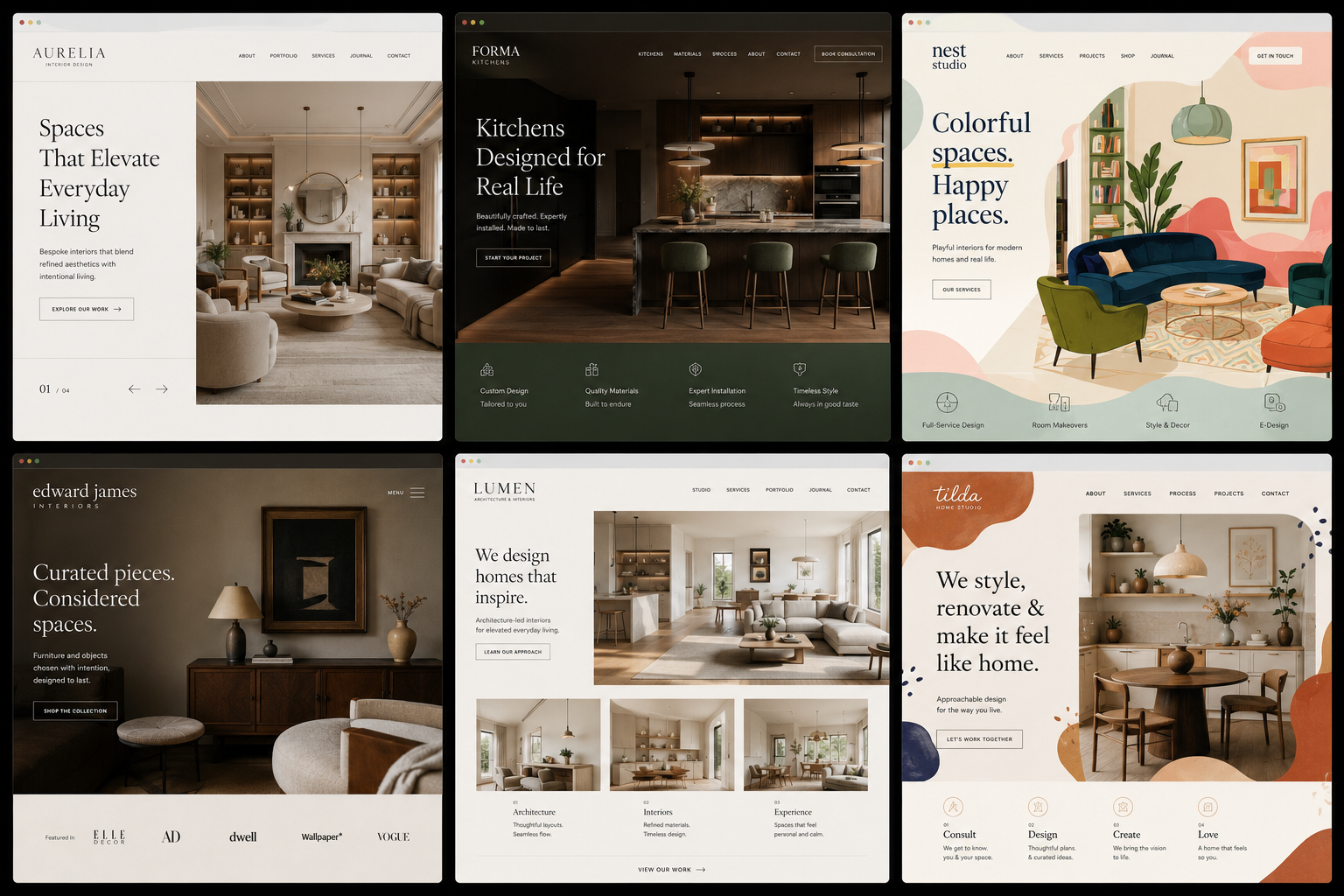
Service pages should make the next step obvious without forcing every visitor through the homepage.
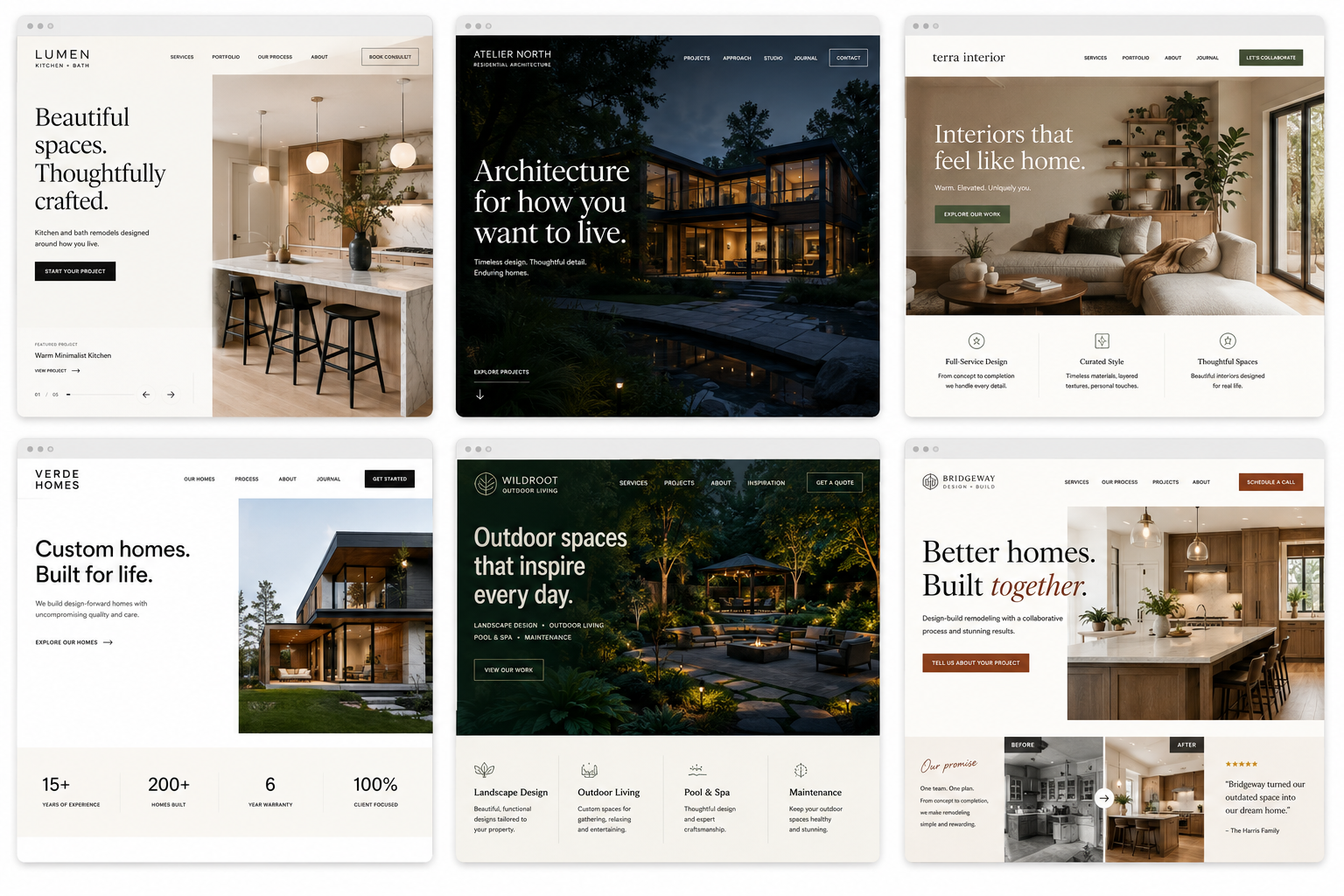
Case-study layouts can turn gallery images into buyer confidence.
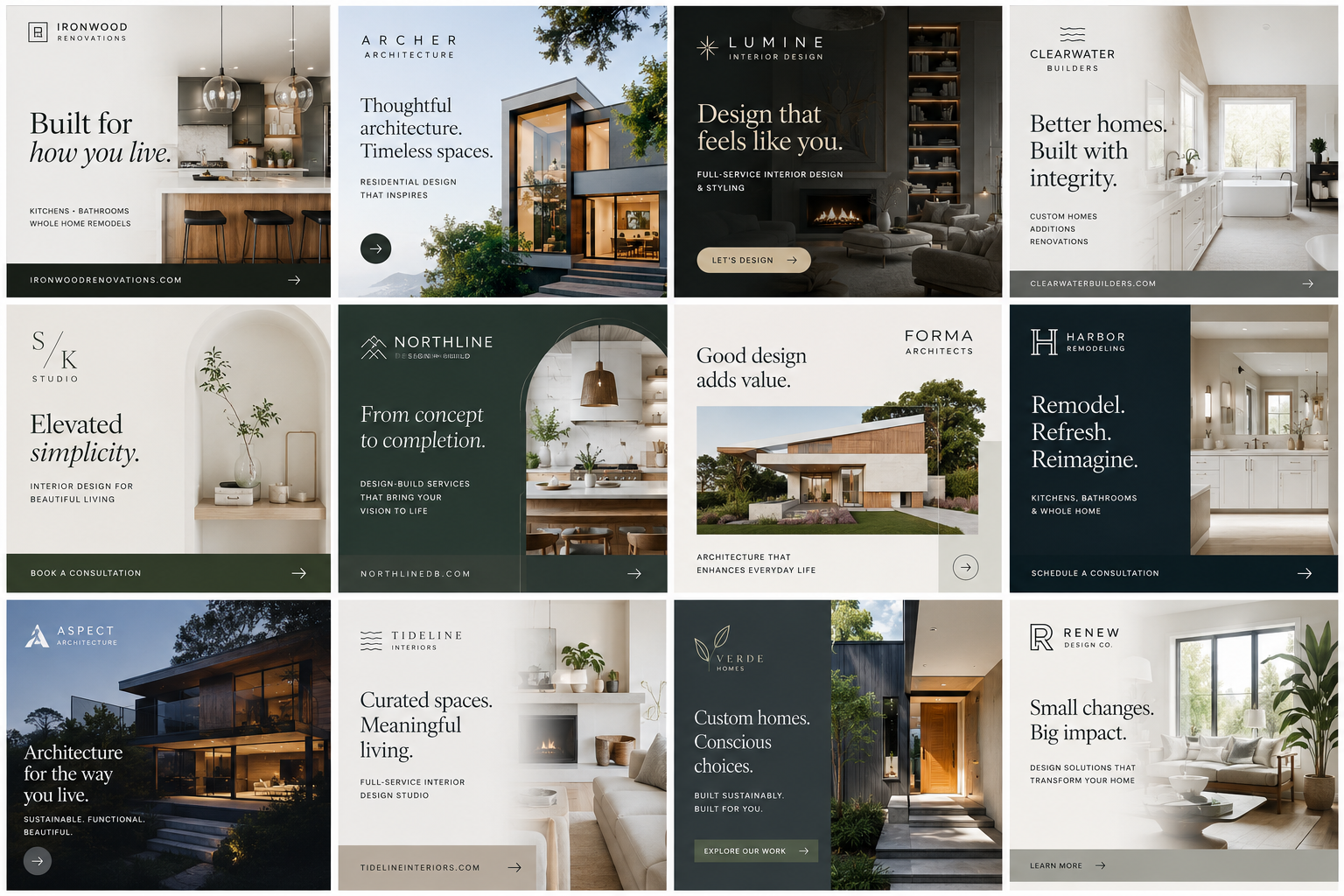
Finished projects can become educational posts, not just before-and-after images.

Social should send people back to useful destinations: service pages, process pages, and project stories.
Recommended Action Plan
The sequence matters. Fix measurement and trust first. Then build pages and proof. Then amplify what is working.
Now
Foundational or urgent work
Validate form, calls, and tracking
Why: You cannot improve what you cannot see. The form path also needs a fallback.
First step: Test live mobile form submissions, click-to-call, GA4 events, and notifications.
Watch: Tracked calls, form starts, form submissions, and form errors.
Clean up entity consistency
Why: Name, phone, email, address, and brand variants create avoidable trust friction.
First step: Build one master NAP/entity sheet and audit priority profiles.
Watch: Citation consistency and GBP/profile accuracy.
Clarify cost and timeline messaging
Why: Basement buyers need realistic expectations before they call.
First step: Consolidate the current FAQ and legacy FAQ into one updated version.
Watch: Fewer repeated objections in sales conversations.
Next
Conversion and authority work
Build core service pages
Why: High-intent visitors need pages that match the project they are considering.
First step: Start with basement finishing, bathroom additions, bedroom/egress, and wet bars.
Watch: Service-page traffic, inquiries, and service requested.
Create three to five case studies
Why: Project stories make the gallery useful for comparison, not just inspiration.
First step: Pick one full basement, one bathroom, one wet bar, one theater/custom space, and one guest suite or bedroom project.
Watch: Case-study views and assisted estimate requests.
Improve lead intake quality
Why: Your team should know project type, city, timeline, and fit before follow-up.
First step: Add optional fields without making the form feel like a contract.
Watch: Qualified inquiry rate and lead-to-consultation rate.
Later
Scaling and expansion
Build validated service-area pages
Why: Local pages work when they are backed by real proof, not when they are mass-produced.
First step: Pull completed project history by city or neighborhood.
Watch: Local page inquiries by geography.
Create a project repurposing rhythm
Why: Every finished basement should strengthen the website, GBP, social, SEO, and sales process.
First step: Use one project intake template for photos, scope, timeline, and quote permission.
Watch: Assets produced per project and new review velocity.
Test narrow paid search
Why: Paid traffic is more useful after tracking and service landing pages are ready.
First step: Test only high-intent basement terms to service-specific landing pages.
Watch: Cost per qualified consultation, not just cost per click.
Guardrails
Do not claim a current review count unless it is verified. Do not create thin city pages without real local proof. Do not publish credential or affiliation claims without confirming they are current. Do not send paid traffic to pages that are not tracked or service-specific.
Practical 90-Day Roadmap
This roadmap is about building the operating foundation. It is not a promise of rankings, revenue, or lead volume.
Measurement and clarity
Focus: Make sure the site can capture and measure inquiries reliably.
- Test forms, mobile click-to-call, and notifications.
- Configure or validate GA4, call events, and form events.
- Create a master entity/NAP sheet.
- Clarify cost, timeline, and FAQ conflicts.
Success signal: Calls and forms are tracked, and the business has one clean source of truth for public identity.
Core pages and proof
Focus: Give high-intent visitors better destinations than the homepage alone.
- Publish the basement finishing page.
- Draft bathroom, bedroom/egress, wet bar, and custom basement pages.
- Create the first two case studies.
- Add relevant testimonials near CTAs.
Success signal: Service-specific inquiries can be tied to pages and project types.
Distribution and repetition
Focus: Make project proof repeatable across website, GBP, social, and sales.
- Publish additional case studies.
- Start a review request workflow.
- Repurpose projects into social and GBP updates.
- Validate location-page opportunities from real project history.
Success signal: Content production becomes repeatable, and inquiry quality is visible by source and service.
Conversion Experiments
These are practical tests, not predicted winners. Track them before judging them.
Hero proof + CTA test
Low effortHypothesis: A hero that includes basement-specific proof will increase qualified contact actions.
Track: Click-to-call, form starts, form submissions, and scroll depth.
Form fallback test
High confidenceHypothesis: A non-JavaScript fallback and visible phone/email backup will reduce lost inquiries.
Track: Form errors, successful submissions, and phone clicks from the estimate area.
Light qualification form
DirectionalHypothesis: Optional fields for project type, city, timing, and photos will improve lead quality without hurting volume too much.
Track: Completion rate, qualified inquiry rate, and lead-to-consultation rate.
Case-study CTA test
Moderate effortHypothesis: “See a similar basement project” will convert better than gallery-only browsing.
Track: Case-study clicks, time on page, and assisted estimate requests.
Sticky mobile call CTA
DirectionalHypothesis: A persistent mobile call/request bar will increase mobile contact actions.
Track: Mobile click-to-call, form starts, and bounce behavior.
Cost/timeline block before form
Low effortHypothesis: Answering cost and timeline concerns before the form will improve project-fit quality.
Track: Qualified form submissions and common objection notes from consultations.
Review proof near CTA
High confidenceHypothesis: Testimonials placed near action points will reduce hesitation.
Track: CTA clicks, form starts, and form submissions from service pages.
Service-specific CTA labels
DirectionalHypothesis: Labels like “Plan your basement bathroom” or “Check bedroom feasibility” will feel more relevant than generic estimate copy.
Track: Service-page conversion rate and service requested.
Measurement Plan
The right scorecard is not raw traffic by itself. The scorecard is right-fit basement inquiries, booked consultations, project fit, and eventually signed work by service type.
Tracked phone actions from website and local profiles.
Completed estimate requests and form-start behavior.
Inquiries that match service area, scope, timeline, and project fit.
Booked estimate visits or serious project conversations.
| KPI | Definition | Required tracking | Why it matters | Review cadence |
|---|---|---|---|---|
| Qualified inquiries | Calls or forms that meet service-area and project-fit criteria. | Form fields, call notes, CRM/source tags. | Measures real pipeline, not just contact volume. | Weekly |
| Service requested | Basement finish, bathroom, bedroom/egress, wet bar, custom, or remodel. | Form dropdown and CRM field. | Shows which pages and services deserve more attention. | Monthly |
| Geography | City, neighborhood, or service-area location. | Form field and call intake notes. | Helps validate location pages and local proof opportunities. | Monthly |
| Lead source | Organic, GBP, referral, paid, social, direct, or email. | UTMs, call tracking, CRM source capture. | Shows which channels bring right-fit projects. | Monthly |
| Organic landing pages | Pages that start converting visits. | GA4 and Search Console. | Validates whether service and content pages are doing their job. | Monthly |
| Review velocity | New reviews requested and received by platform. | Review request log and platform monitoring. | Sustains trust and local reputation signals. | Monthly |
| Lead-to-consult rate | Consultations divided by qualified inquiries. | CRM or lead spreadsheet. | Shows whether inquiry quality and follow-up are improving. | Monthly |
| Consult-to-project rate | Signed work divided by consultations, when measurable. | Sales and CRM data. | Connects marketing to actual jobs, not vanity metrics. | Monthly or quarterly |
Where GYRO and Megaphone May Help
Solid Rock’s opportunity is not one random campaign. It is a connected system: position, proof, website structure, local visibility, content repurposing, conversion tracking, and ongoing refinement.
MOD clarity
A Master Organization Document could capture Solid Rock’s services, proof, voice, service area, project types, FAQs, differentiators, and best-fit customers before more content is produced.
Website and content system
Megaphone could help turn the existing FAQ, gallery, testimonials, and service mix into service pages, case studies, cost/process guides, and local education.
Local and GEO readiness
Cleaner entity information, service pages, review proof, and structured local content can make the business easier for search engines and AI-assisted search systems to understand.
Project repurposing
Each finished basement can become more than a gallery image: a case study, social sequence, GBP update, FAQ, and sales aid.
Conversion support
The estimate path can be made more resilient, clearer on mobile, more trust-building, and better at capturing project-fit details.
Measurement and refinement
The system should track calls, forms, qualified inquiries, service requested, geography, consultations, and project fit so decisions are based on real pipeline signals.
Research Limitations
This audit is based on outside-in public information. That is enough to identify meaningful opportunities, but it is not the same as having access to the business’s internal data.
Internal access would sharpen the next round of decisions
The next layer would require Google Analytics, Search Console, Google Business Profile access, CRM or lead data, call tracking, form data, lead quality, booked consultations, close rates, revenue by service, ad accounts, customer research, sales-process details, warranty/follow-through policy, and real project history by city or neighborhood.
This limitation does not weaken the main finding: Solid Rock has a strong basement-specialist foundation. The public-facing system simply needs better organization, cleaner entity signals, stronger proof packaging, and measurement tied to right-fit inquiries.
Solid Rock has strengths worth amplifying.
Your clearest opportunity is not to sound more like every other remodeler in Colorado Springs. It is to make your basement-specific proof easier to see, easier to trust, and easier to act on.
The recommendations in this audit can be implemented independently. A practical next conversation would be to choose the first 30 days of work: tracking, entity cleanup, form resilience, and the first service-page or case-study build. From there, GYRO and Megaphone could help connect the pieces into a repeatable system rather than another batch of disconnected marketing tasks.