
Potter Lawson, Inc.
A practical outside-in review of Potter Lawson’s positioning, digital presence, portfolio proof, local search visibility, conversion path, and growth opportunities. This report is built from the available Stage 1 research and is designed to be useful whether your team implements it independently or with outside support.
Important location note. The original project request referenced New York, New York. The Stage 1 research packet found that Potter Lawson’s public-facing business information points instead to Madison, Wisconsin. This report therefore evaluates Potter Lawson as a Madison-based architecture, planning, and interior design firm, and treats any New York-specific assumptions as unverified.
Research emphasis: official firm website first, then public-facing company pages, public records where accessible, competitor websites, and industry context already captured in the Stage 1 packet.
Executive summary
For Potter Lawson, the clearest opportunity is not inventing a new reputation. It is translating a strong real-world reputation into a more searchable, more current, and more conversion-ready digital presence.
Real design credibility already exists
Potter Lawson benefits from a long history, visible leadership, an established Wisconsin legacy, a broad sector mix, and a portfolio that includes major corporate, education, healthcare, government, hospitality, and civic work.
Digital clarity lags behind offline substance
The current website presents quality work, but the Stage 1 packet suggests that the firm’s digital story is less explicit than it should be around freshness, entity clarity, case-study depth, and buyer-focused explanation.
Rebuild the site around proof, sectors, and conversion
Stronger service pages, richer project stories, clearer calls to action, and a more current homepage would make it easier for prospective clients to understand why Potter Lawson is a fit.
Shift from gallery-first to decision-support
Your website currently makes it easy to see attractive work. It could do a better job helping a prospect understand project type, scale, process, outcomes, and the next step to start a conversation.
Own the Madison narrative more assertively
The reviewed research points to a meaningful opening around “Madison architecture firm,” workplace design, higher education, healthcare, hospitality, adaptive reuse, and civic design messaging tied to local proof.
Clarify, modernize, instrument, then scale
Start by resolving entity and location ambiguity, updating trust and freshness signals, tightening tracking, and building flagship service pages and case studies. Then layer on content, PR, local authority, and repurposed social proof.
Strategic thesis. Potter Lawson already has a useful foundation in heritage, design credibility, and local trust. The most practical growth plan is to make those assets easier for modern buyers, search engines, and AI-assisted discovery systems to recognize, understand, and act on.
Business snapshot
This section combines the firm overview, services and specialties, key public personnel, and the strongest proof signals from the Stage 1 packet.
Long operating history
The public-facing story gives Potter Lawson an unusually durable heritage profile. That history helps support credibility with institutional, civic, and relationship-driven buyers.
Service mix
Publicly emphasized services include master planning, architecture, interior design, furniture and artwork support, sustainable design, cost estimating, and construction contract administration.
Published portfolio scale
The Stage 1 packet cites published ten-year project-value totals across corporate, education, healthcare, and government work. That supports a substantial regional-market presence.
Business size signal
The packet treated the firm as a well-established regional practice, with a directional annual revenue estimate in the roughly $10M to $16M range. This should be treated as directional rather than reported.
Firm overview
Potter Lawson presents itself publicly as a design-led architecture, planning, and interior design firm. The strongest commercial impression is not that of a giant multidisciplinary platform, but of a mature regional practice with meaningful project credibility and a partner-led feel.
The Stage 1 packet points to Madison, Wisconsin as the firm’s supported headquarters, rather than New York. That matters commercially because local search, geographic trust signals, directory consistency, and market positioning all depend on the business location being explicit and consistent everywhere your brand appears.
For Potter Lawson, the practical positioning lane is clear: a heritage-rich, design-forward firm serving employers, institutions, healthcare systems, public clients, hospitality and mixed-use stakeholders, and organizations that value design quality and principal attention.
Services and specialties
Core design services
Architecture, interior design, and master planning form the center of the firm’s public offer. This creates a broad enough platform to compete across multiple sectors without diluting the design-led identity.
Project-support services
Sustainable design, cost estimating, furniture and artwork support, code expertise, and construction contract administration add practical depth and can reduce client friction when explained more clearly on the site.
Most valuable specialties
The Stage 1 packet suggests the highest-value and best-supported specialties are corporate workplace, higher education, science and research environments, healthcare, civic and public work, hospitality, mixed-use, and adaptive reuse.
Key public personnel and role signals
| Person | Public role | What the public-facing bio suggests | Commercial relevance |
|---|---|---|---|
| Rebecca Prochaska | President + CEO | Presented as the leader of strategy, innovation, and overall management, with visible stewardship of the firm’s history and direction. | Strong executive signal for clients who want continuity, vision, and clear leadership. |
| Beth Prochaska | Chairman of the Board | Publicly associated with long tenure, strategic market placement, client engagement, and civic leadership. | Supports trust, continuity, and community-rooted positioning. |
| Doug Hursh | Principal, Director of Design | Presented as design leadership focused on translating client vision into built form. | Important proof point for design-oriented buyers. |
| Jody Shaw | Principal, Architect and Sustainable Design Leader | Associated with collaboration, master planning, consensus-building, and sustainability. | Useful for institutional and process-sensitive projects. |
| Chad Oistad | Principal, Director of Operations | Presented as a leader tied to operations, specifications, cost estimating, and quality procedures. | Helpful for clients who need confidence in delivery, documentation, and risk management. |
Portfolio highlights
The Stage 1 packet verified strong project proof and official project galleries, but it did not carry through stable image asset URLs for direct embedding. To remain factual, the WordPress-ready build below uses image-ready portfolio cards and marks image URLs as unspecified rather than inferring them.
Innovation One HQ
A major workplace project publicly described as a five-story headquarters with nearly 147,000 square feet. This is one of the best pieces of proof for Potter Lawson’s corporate and interior architecture credibility.
Image URL: unspecified
DreamBank
This project helps show that Potter Lawson can shape branded, community-facing environments rather than only conventional office interiors.
Image URL: unspecified
Adaptive Reuse
The adaptive reuse story is commercially important because it shows the firm can work in hospitality and redevelopment contexts where history, placemaking, and constraint management matter.
Image URL: unspecified
for the Arts
A major civic project associated with executive architect responsibilities. This materially strengthens the firm’s public and cultural-project credibility.
Image URL: unspecified
Market position
This analysis blends current positioning, customer fit, a directional outside-in scorecard, and a practical SWOT view of where Potter Lawson seems strongest and where the brand deserves prompt attention.
Current positioning
The public-facing message suggests a confident regional design practice with deep roots, broad sector coverage, and meaningful project experience. That is a good starting point. Where the message still feels lighter than it should is in explaining exactly how the firm helps a buyer make a decision, especially when the project is large, complex, or still at the early planning stage.
The Stage 1 packet suggests that Potter Lawson is at its best when it acts less like a generic architecture firm and more like a design-led advisor for organizations that care about workplace quality, civic impact, hospitality character, educational environments, and thoughtful execution.
Outside-in marketing scorecard
This is a directional outside-in scorecard based on publicly observable signals. It is not a substitute for analytics, CRM data, Search Console, or deeper conversion measurement.
The firm appears to have more than enough real project substance to support a powerful website and search narrative.
Public leadership roles and bios add reassuring depth and reduce the impression of a faceless studio.
The offer is broad enough to win meaningful work, though it could be organized more decisively around buyer needs.
The Stage 1 packet flagged a notable discrepancy between the request assumptions and public business identity signals.
The website’s public cues appear less current than the quality of the work itself, which may reduce trust at the margin.
Prospects can see the work, but the path from interest to consultation could be more explicit and more thoughtfully qualified.
There is evidence of useful structure, but not yet a strong enough educational or case-study engine to match the firm’s real strengths.
Several important items such as schema, sitemap quality, canonical control, and analytics setup were not fully verifiable in public review.
The brand has strong underlying proof, but entity clarity, structured corroboration, and answer-oriented content appear underdeveloped.
SWOT analysis
Strengths
- Long heritage and strong local identity
- Meaningful project scale across multiple sectors
- Visible leadership and principal credibility
- Recognizable client roster and civic proof
Weaknesses
- Public location and entity story needs clarity
- Website freshness cues appear dated
- Project pages often need more context, outcomes, and buyer-relevant detail
- Technical and measurement readiness is not yet clearly demonstrated from outside-in review
Opportunities
- Own the Madison design narrative more clearly
- Publish stronger service pages and flagship case studies
- Repurpose awards, community visibility, and LinkedIn momentum into website trust signals
- Use heritage as a differentiator without letting historical references overshadow the current brand
Threats
- Larger Madison-office competitors have stronger content engines and broader platform depth
- Brand ambiguity can make referrals and search discovery less efficient
- Economic softness in office or private development can put more pressure on message clarity and pipeline quality
- Moving into additional states without a fully consistent public business profile creates avoidable friction
Digital audit
This section covers brand and messaging, website structure, technical and UX observations, organic search and content architecture, local presence, reputation use, and AI-search readiness. Each area distinguishes what was observed, why it matters, and what should happen next.
Brand and messaging
What was observed. Potter Lawson’s current public story communicates quality, longevity, and sector range. The site appears visually polished and portfolio-rich. At the same time, the Stage 1 packet suggests that the message is often more descriptive than decisive. In plain language, a prospect can tell the firm does serious work, but may not quickly understand why Potter Lawson is the right fit for a specific project type or what the first engagement step should be.
Why it matters. Architecture buyers are not only buying design taste. They are also buying uncertainty reduction. A better message lowers friction around project fit, process, complexity, and confidence in the team.
What should happen next. Rewrite the homepage and priority service pages to lead with sector-aligned problems solved, not only broad capability. Tie the message more explicitly to employers, institutions, healthcare stakeholders, civic organizations, and hospitality or redevelopment clients.
Website structure and user experience
The underlying information architecture appears workable. The public navigation suggests a homepage, about and team content, services, culture and sustainability pages, careers, portfolio categories, and contact. That is enough to support a strong digital platform if the hierarchy becomes more conversion-minded.
Practical UX implication: the site likely needs fewer passive transitions between portfolio browsing and inquiry behavior. Project pages should do more to move the right visitor toward a conversation, especially on mobile.
Technical SEO, performance, accessibility, mobile, schema, sitemap, and robots
| Area | Public Stage 1 view | Why it matters | Recommended next step | Status |
|---|---|---|---|---|
| HTTPS and modern CMS signals | The packet suggested a modern CMS-based site and CDN-served images. | That is a reasonable technical base, but not enough by itself to guarantee crawl health or conversion readiness. | Validate platform-level maintenance, image compression, and page-template consistency. | Developing |
| Titles and local intent | The packet noted locally oriented titling patterns such as Madison and Dane County architecture language. | Helpful signal for search intent, but title strategy should be strengthened by service and sector relevance. | Create a title and meta framework for the homepage and each priority sector page. | Competitive |
| Canonical tags, robots, XML sitemap | Not fully verified in public review. | These affect crawl governance, duplicate content control, and index quality. | Run a manual crawl and verify robots, XML sitemap, canonical behavior, redirect hygiene, and indexable page set. | Requires internal validation |
| Schema markup | Not fully inspectable from the Stage 1 packet. | Schema helps reinforce who the firm is, where it operates, and what services and projects it is known for. | Add and validate organization, local business, person, breadcrumb, and article or project-related structured data where appropriate. | Requires internal validation |
| Performance | No measured performance scores were carried through in the packet; observations were qualitative. | Image-heavy portfolio sites often create mobile friction if not carefully optimized. | Test core templates with real performance tools and prioritize image sizing, lazy loading, and layout stability. | Requires internal validation |
| Accessibility and usability | The packet judged usability directionally decent, but not demonstrably strong. | Accessibility supports trust, findability, and better mobile conversion behavior. | Audit heading structure, alt text, keyboard focus, mobile tap targets, contrast, and form labeling on core templates. | Developing |
| Mobile conversion path | The site appears visually capable, but the packet suggests the conversion path should be clearer and more explicit. | Many first-touch visitors will evaluate the firm on a phone before shifting to desktop or direct outreach. | Add more visible inquiry paths, consultation guidance, and high-value proof closer to the points where interest turns into action. | Needs attention |
Organic search and content architecture
What was observed. The Stage 1 packet suggests that Potter Lawson has enough raw material for a strong organic presence, but not yet enough answer-oriented content or conversion-aware service architecture to extract the full value from that material.
Why it matters. In architecture, a modern organic strategy is not merely about ranking for a city phrase. It is about owning the decision journey: problem discovery, service education, project qualification, sector proof, and confidence-building content.
What should happen next. Build or strengthen pages around corporate workplace, healthcare, higher education and research, civic and public work, hospitality and adaptive reuse, and master planning. Support those pages with project proofs, FAQs, process guidance, and buyer-language copy.
| Keyword and topic cluster | Why it fits the packet | Recommended asset | Priority |
|---|---|---|---|
| Madison architecture firm | Direct local identity term and a high-value brand-control signal | Sharper homepage title, location clarity, and heritage-plus-today copy | Immediate |
| Commercial architect Madison WI | Strong fit with the corporate, civic, mixed-use, and institutional portfolio | Commercial and workplace landing page supported by flagship project proof | High |
| Workplace design and interior architecture | Supported by Exact Sciences, DreamBank, and other corporate proof | Dedicated workplace page plus case studies and insights | High |
| Higher education and research architect Wisconsin | Supported by university and science-related proof | Sector page with research, teaching, and planning content | High |
| Healthcare design Madison WI | Supported by healthcare and wellness-oriented project material | Healthcare page with workflow and flexibility messaging | High |
| Hospitality and adaptive reuse | Strong story lane based on Hotel Indigo and related redevelopment work | Adaptive reuse and hospitality page tied to place-based case studies | High |
Recommended page-structure direction
| Page type | Recommended title direction | Meta description direction | Primary job of the page |
|---|---|---|---|
| Homepage | Potter Lawson | Architecture, Planning and Interior Design in Madison, WI | Clarify geography, project types, heritage, and who the firm serves. | Control the brand narrative and direct visitors into sector-relevant paths. |
| Workplace service page | Workplace and Corporate Design in Madison, WI | Potter Lawson | Connect strategy, interiors, employee experience, and project proof. | Convert commercial and employer-led interest. |
| Education and science page | Education and Research Facility Design | Potter Lawson | Explain learning, research, planning, and technical environment experience. | Support institutional search and referral traffic. |
| Healthcare page | Healthcare and Wellness Design | Potter Lawson | Frame flexibility, workflow, and user-centered care environments. | Reduce friction for healthcare-related prospects. |
| Hospitality and adaptive reuse page | Hospitality and Adaptive Reuse Architecture | Potter Lawson | Cover redevelopment, placemaking, historic context, and user experience. | Differentiate the firm in a valuable narrative lane. |
Local search, reviews, and entity consistency
The most important issue here is simple: the firm’s public location story needs to be precise everywhere. The Stage 1 packet found evidence supporting Madison, Wisconsin rather than New York. For local SEO, map visibility, directory consistency, and AI-assisted discovery, ambiguity is expensive even when the underlying business is highly credible.
The reviewed material also suggests that Potter Lawson’s owned reputation assets are stronger than their current on-site use. Testimonials, awards, community involvement, recognizable clients, and leadership credibility should appear closer to conversion points and should reinforce service pages rather than living mostly as background proof.
What appears strong
- Useful official contact information and clear headquarters signal in the Stage 1 packet
- Strong testimonial material from recognizable organizations
- Awards and public recognition that can support trust and freshness
What deserves prompt attention
- Normalize business name, address, and geographic language across every owned profile
- Bring more testimonials and proof points into service and project pages
- Validate and strengthen local profile activity, photos, and service framing
Portfolio, social, and AI-search readiness
Potter Lawson appears to have enough portfolio depth and recent social activity to support a much stronger authority engine than what is currently visible on the website. The strongest path is not generic blog output. It is project-led authority: case studies, sector FAQs, process guidance, award summaries, project milestones, and short-form visual repurposing built from existing work.
From an AI-search and general entity-readiness perspective, the business already has important raw ingredients: a specific service mix, public leadership, a historic identity, recognizable clients, and meaningful projects. What seems underdeveloped is the connective tissue that lets search systems corroborate the full picture: structured entity cues, richer informational content, clearer service-location consistency, and more current third-party support.
Portfolio, customer journeys, and conversion
This section focuses on how prospects likely move from awareness to contact, where trust is already strong, and where practical conversion friction may be limiting qualified inquiries.
Three customer journeys
Already knows the name
This visitor usually needs confirmation: Is Potter Lawson still active, current, credible, and suited to this project type?
Current friction: freshness cues and detailed next-step guidance appear lighter than they should be.
Recommended improvement: make the homepage and about pages more current, and place a simple inquiry path alongside strong proof.
Primary conversion action: direct consultation inquiry.
Comparing firms right now
This visitor needs sector fit, clear service language, proof, and a sense of how Potter Lawson handles complexity.
Current friction: a portfolio-rich presentation can still leave room for uncertainty if service pages and case studies do not answer practical questions.
Recommended improvement: build decision-oriented service pages supported by project outcomes, team context, and FAQ content.
Primary conversion action: service-page inquiry or short consultation request.
Curious but not fully committed
This visitor may arrive from images, social content, news, awards, or referral conversation and needs reasons to stay engaged.
Current friction: the pathway from inspiration to useful education is not yet strong enough.
Recommended improvement: use project stories, design FAQs, and short educational content to nurture interest.
Primary conversion action: explore a case study, sign up for updates if appropriate, or request an early conversation.
Trust-gap inventory
Process explanation
Weak to developing
Buyers often need more clarity on how planning, design, documentation, and construction-administration support will unfold.
Team visibility
Present
Leadership bios are a strong trust asset and should be better connected to sector pages and major proofs.
Project scope and outcome detail
Needs attention
Many buyers want year, scale, role, challenge, outcome, and stakeholder context before they contact a firm.
Budget and timeline guidance
Often missing
The Stage 1 packet suggests more decision-support content could help serious prospects self-qualify.
Client quotes near conversion points
Underused
Strong testimonials exist, but they should work harder near service pages, project pages, and inquiry prompts.
Consultation expectations
Could be clearer
A short explanation of what happens after contact would lower friction for first-time prospects.
Lead quality and form-friction review
Because the Stage 1 packet did not include access to forms, analytics, or CRM records, this section is directional. The main recommendation is not “add more fields” or “remove all fields.” It is to align the contact path with project fit. For a firm like Potter Lawson, the best outcome is not maximum inquiry volume. It is better-qualified conversations.
What should change
- Make the primary inquiry path more visible on the homepage and service pages
- Explain what a first conversation is for and who it is best suited to
- Consider lightweight qualification fields for project type, timeline, and location
- Place relevant project proof and client quotes near inquiry prompts
- Strengthen mobile click-to-contact behavior where appropriate
Why it matters
This helps filter out weak-fit leads without making serious prospects feel screened out too early. It also improves internal follow-up by giving the firm better context at the moment the inquiry arrives.
Primary success signal: a rising share of leads that are clearly aligned with target sectors, project scale, and geography.
Competitive benchmark and local market analysis
Because the Stage 1 packet identified Madison, Wisconsin as the supported public geography, the local market analysis below is framed around Madison and southern Wisconsin competition rather than New York. The key question is not who has the biggest platform. It is where Potter Lawson has a fair, profitable opening.
The reviewed competitive field suggests a familiar pattern: larger firms often have stronger content engines, more current digital publishing, and broader multidisciplinary depth. Potter Lawson’s opening is different. It sits at the intersection of local trust, design quality, established relationships, legacy, and principal-level engagement. That is an appealing position if the website and search presence make it visible enough.
| Name | Website | Size | Specialties | Notable projects | Estimated revenue |
|---|---|---|---|---|---|
| Flad Architects | Official website reviewed | 320+ creative professionals publicly referenced in the Stage 1 packet | Health, academia, and science; integrated planning, interiors, sustainable design, and engineering-adjacent depth | Unspecified in the Stage 1 packet | Unspecified in the Stage 1 packet |
| EUA | Official website reviewed | Unspecified in the Stage 1 packet | Architecture, engineering, planning, experiential design, sustainability, learning, workplace, healthcare, living, science and tech | Unspecified in the Stage 1 packet | Unspecified in the Stage 1 packet |
| HGA | Official website reviewed | Unspecified in the Stage 1 packet | Architecture, engineering, interiors, resilience, research, workplace, healthcare, higher education, science and technology, arts and culture | Unspecified in the Stage 1 packet | Unspecified in the Stage 1 packet |
| OPN Architects | Official website reviewed | Unspecified in the Stage 1 packet | Design-forward Midwest work with strong innovation, sustainability, analytics, and community-centered positioning | Unspecified in the Stage 1 packet | Unspecified in the Stage 1 packet |
| JLA Architects | Official website reviewed | Unspecified in the Stage 1 packet | Mixed-use, multifamily, hospitality, civic, community, corporate, and education work with a more conversion-minded site style | Unspecified in the Stage 1 packet | Unspecified in the Stage 1 packet |
Competitive opening in plain English
Potter Lawson should not try to out-scale Flad, out-platform EUA, or out-publish HGA using generic content alone. The stronger opening is to own a sharper lane: a Madison-rooted firm with real civic and institutional credibility, high-quality design, strong workplace and adaptive-reuse proof, and more direct principal access than many larger competitors can offer.
That opening becomes much more powerful when the website tells a clearer story. Right now, larger competitors appear more fluent in digital decision-support content. Potter Lawson already has the raw proof required to compete better than its current website suggests.
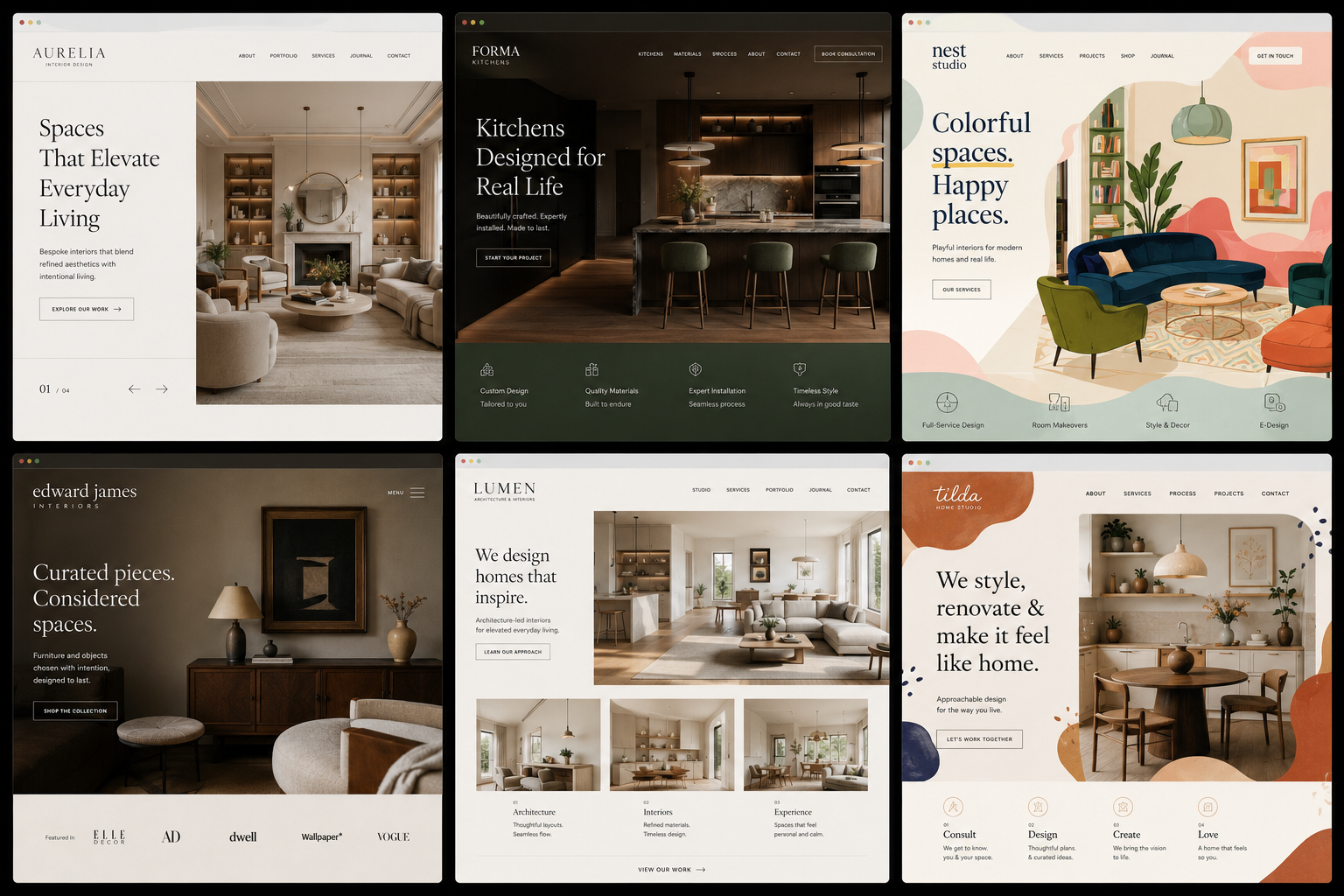
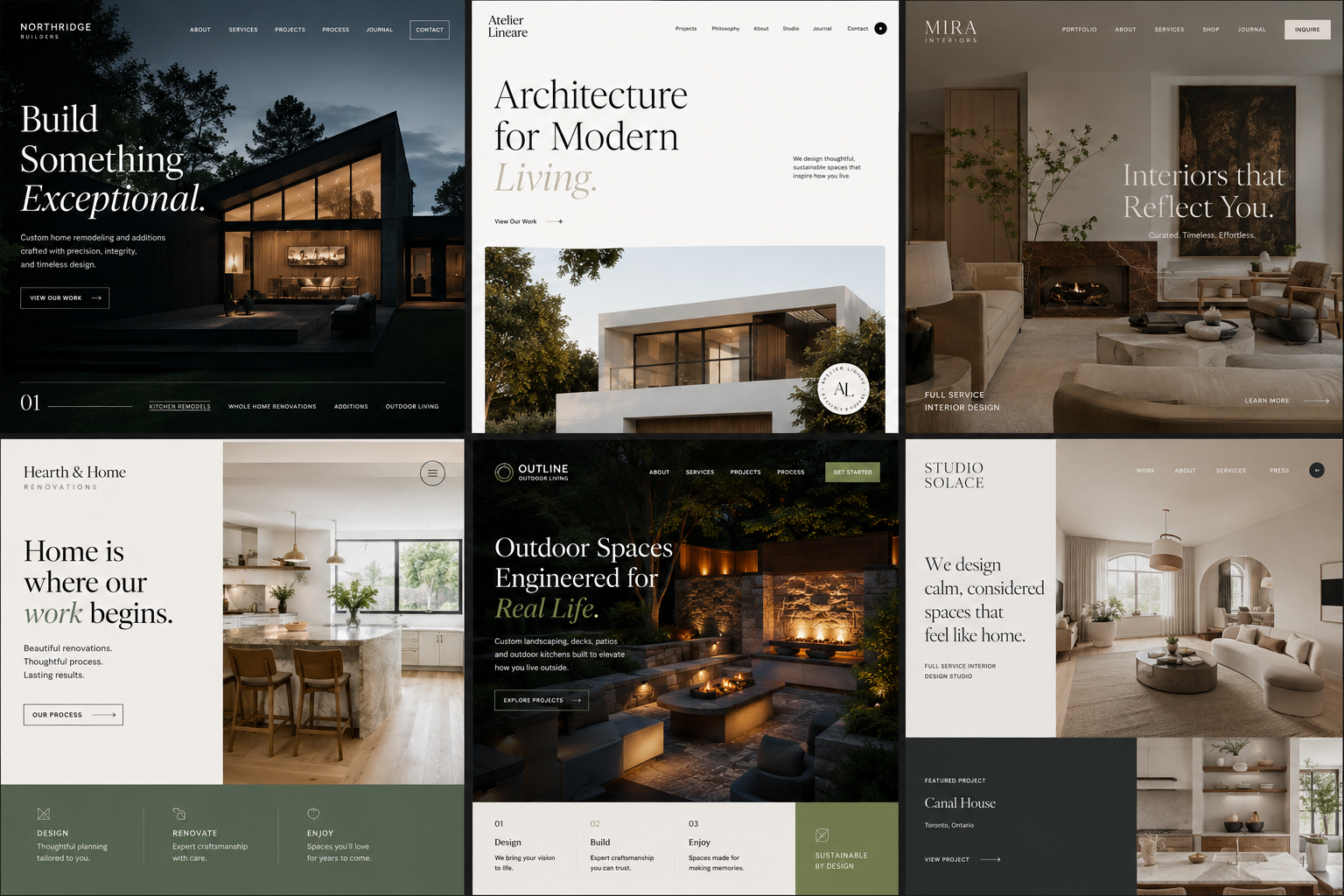
What good portfolio presentation could look like
The examples below are not presented as competitor work. They are included to show the kind of clearer visual hierarchy and case-study framing that could help Potter Lawson’s own portfolio work harder.
Search, content, authority, and lead-generation opportunities
The best opportunities are tightly connected. Stronger pages improve search, better case studies improve trust, more useful social and local content improves visibility, and cleaner calls to action improve lead quality.
Entity and location normalization
Why it matters. Search systems, referrals, and AI-assisted answers need a stable understanding of who the firm is and where it operates.
Recommended asset. Update the homepage, contact page, profile language, and about content so the current geography and public business story are unmistakable.
Suggested CTA. “Start a conversation about your project” supported by location and project-type clarity.
Sector-first service pages
Why it matters. Buyers search and evaluate by project context, not only by firm name. Potter Lawson’s strongest sectors deserve dedicated pages with proof and FAQs.
Recommended asset. Corporate and workplace, higher education and research, healthcare, hospitality and adaptive reuse, civic and public work, and master planning.
Suggested CTA. Book a discovery conversation or request a project-fit discussion.
Case-study engine
Why it matters. Potter Lawson appears to have enough marquee work to build an excellent case-study library. This is one of the best ways to support search, referrals, proposals, and sales conversations at once.
Recommended asset. Four to six flagship projects written in a consistent format: client context, challenge, scope, role, constraints, outcomes, testimonial, and next step.
Suggested CTA. “See similar work” followed by a consultation path.
Content repurposing and local authority
Why it matters. Awards, LinkedIn activity, community visibility, and project milestones already exist. They should reinforce the website, local profile activity, search visibility, and ongoing brand recall.
Recommended asset. Monthly project-led insights, short update posts, award roundups, partner stories, and FAQ-led social content.
Suggested CTA. Guide readers from social and updates into stronger service pages and case studies.
Marketing and lead-generation strategy
Why it matters. For a firm like Potter Lawson, growth usually comes from a coordinated mix of referrals, organic discovery, thoughtfulness in follow-up, and being easier to evaluate than competing firms.
Recommended asset. A repeatable system connecting website updates, case studies, LinkedIn content, local activity, award submission cadence, and qualified inquiry handling.
Suggested CTA. Keep calls to action low-pressure but specific, with a visible promise of what happens after contact.
Project-to-content repurposing model
Case study
Turn a flagship project into a full narrative that shows scope, role, constraints, outcomes, and client context.
Social sequence
Break the project into multiple short-form posts: challenge, concept, planning insight, finished impact, and testimonial proof.
Short video or reel
Use project images, plans, leadership commentary, and concise overlays to give the firm a more current public voice.
Local profile update
Repurpose project news or awards into local profile posts that reinforce visibility and freshness.
FAQ and service-page proof
Use the project to answer buyer questions about process, project type, timeline, complexity, or adaptive reuse considerations.
Sales support
Package the same story for proposals, credential decks, and consultation follow-ups so the website and sales process reinforce each other.
Prioritized action plan and roadmap
The most sensible sequence is foundational first, then conversion and authority, then wider distribution and optimization. The goal is not more activity for its own sake. The goal is a stronger operating system for qualified growth.
Now
Clarify entity and location story
Why: reduces trust friction and supports search consistency.
First step: reconcile all owned-site and profile language.
KPI: cleaner conversion behavior from brand traffic and more consistent local identity.
Update freshness signals
Why: stale cues may reduce confidence.
First step: update footer, homepage proof, and recent-award or recent-work modules.
KPI: better engagement on homepage and about pages.
Audit measurement readiness
Why: important changes should be trackable.
First step: validate analytics, events, form tracking, source attribution, and inquiry handling.
KPI: visible reporting on qualified inquiries by source and service.
Next
Rebuild high-value service pages
Why: buyer intent maps to sectors and project types.
First step: prioritize workplace, education and research, healthcare, hospitality and adaptive reuse, and civic work.
KPI: improved landing-page engagement and more relevant inquiries.
Create flagship case studies
Why: case studies strengthen trust, search, and sales simultaneously.
First step: standardize the case-study template and publish the first two to three major proofs.
KPI: deeper engagement with project pages and higher inquiry quality.
Improve conversion paths
Why: the site should support decision-making, not only browsing.
First step: place stronger CTAs, testimonials, and “what happens next” content near inquiry moments.
KPI: lift in consultation requests and lead-to-conversation rate.
Later
Launch a project-led content rhythm
Why: ongoing authority compounds over time.
First step: publish one insight or project-led article per month and repurpose it across channels.
KPI: broader non-brand visibility and more assisted conversions.
Strengthen partner and local authority links
Why: third-party corroboration helps search and credibility.
First step: pursue awards, partner mentions, university and civic references, and relevant business-media visibility.
KPI: stronger referral traffic and improved branded search control.
Test paid amplification only after foundation work
Why: paid traffic performs better when landing pages and attribution are already strong.
First step: evaluate a narrow test only after service pages and tracking are in place.
KPI: cost-per-qualified-conversation, not clicks alone.
Practical 90-day roadmap
Strategic focus: measurement, clarity, and quick trust fixes.
Outputs: location and entity normalization, updated footer and freshness cues, analytics and form-tracking review, technical crawl plan, and rewritten homepage messaging outline.
Success signals: cleaner public business story, current-looking site cues, and visible tracking requirements for core inquiry actions.
Strategic focus: priority service-page development and stronger proof.
Outputs: at least two to three revised sector pages, case-study template, first flagship case studies, and improved inquiry prompts.
Success signals: better landing-page engagement, clearer paths into consultation, and more internally useful lead information.
Strategic focus: authority building and early optimization.
Outputs: one recurring content cadence, local profile and reputation support, social repurposing plan, and the first round of conversion experiments.
Success signals: stronger branded control, deeper project-page engagement, and better visibility into which services and sources produce qualified conversations.
Planning-level cost ranges
| Workstream | What it covers | Planning estimate | Notes |
|---|---|---|---|
| Foundation cleanup | Entity and profile audit, tracking review, technical crawl, freshness updates | $8,000–$20,000 | Best treated as a first-phase cleanup and instrumentation effort |
| Messaging and architecture refresh | Homepage rewrite, sector positioning, heritage page, priority service pages | $15,000–$35,000 | High leverage because it changes what prospects understand first |
| Case-study engine | Flagship project stories, collateral support, supporting visual organization | $18,000–$45,000 | Useful across website, proposals, and social proof |
| Ongoing authority program | Monthly content, local activity, PR, repurposing, light optimization | $6,000–$15,000 per month | Best pursued once core pages and measurement are stronger |
| Annual photo, PR, and award reserve | Photography, video, awards, media support, speaking and reputation assets | $12,000–$35,000 annually | Supports freshness and authority if used consistently |
These are planning estimates carried forward from the Stage 1 research. They are not vendor quotes or guaranteed outcome models.
Conversion experiments
Homepage message test
Hypothesis: a clearer sector-led homepage message will improve early engagement and consultation interest.
Primary metric: inquiry click-through rate from the homepage.
Track first: homepage CTA events and scroll behavior.
Service-page proof stack
Hypothesis: pairing service copy with a testimonial, project summary, and “what happens next” module will produce more qualified inquiries.
Primary metric: service-page inquiry conversions.
Track first: form-start and form-submit events by landing page.
Case-study layout test
Hypothesis: adding challenge, scope, role, and outcomes above the image gallery will increase project-page usefulness.
Primary metric: depth of engagement on flagship project pages.
Track first: scroll thresholds and next-step clicks.
Contact-form qualification test
Hypothesis: lightweight qualification fields will improve lead quality without overly depressing total inquiries.
Primary metric: qualified inquiry rate.
Track first: form abandonment, service selected, and lead-source fields.
Testimonial placement test
Hypothesis: placing relevant client proof near CTAs will reduce hesitation for comparison-stage visitors.
Primary metric: consultation requests from service and portfolio pages.
Track first: page-level CTA click-through by template.
Recent work and awards module
Hypothesis: a current-looking proof module will improve trust for referral visitors who are validating whether the firm is active and relevant now.
Primary metric: homepage engagement and contact-page continuation rate.
Track first: clicks into project and inquiry paths from the homepage.
Measurement, GYRO fit, and research limitations
The best digital strategy is only useful if the business can tell what is improving. This section covers a practical measurement philosophy, a subtle GYRO and Megaphone fit, and the main limitations of an outside-in review.
Measurement plan
For Potter Lawson, the most useful measurement model is not raw traffic-first. It is quality-first. The website should help the business see which sectors, pages, and sources are producing the right type of inquiry, not simply the highest number of clicks.
Qualified inquiries
The most important primary KPI. Define what qualifies by service fit, geography, project type, and likely budget or complexity.
Consultation requests
Track direct requests for conversations, not just generic contact submissions.
Landing pages by inquiry
Identify which service pages, case studies, and brand pages are most often involved before conversion.
Lead source clarity
Capture whether the lead came from search, referral, social, direct, local profile activity, or another source.
| KPI | Definition | Required tracking | Review cadence |
|---|---|---|---|
| Qualified inquiry count | Inquiries judged internally as a plausible fit | Form tracking, call tracking or manual logging, source capture, service tagging | Weekly and monthly |
| Consultation-to-project rate | How often a serious conversation leads to active opportunity | CRM, pipeline discipline, project-type categorization | Monthly and quarterly |
| Organic landing page quality | Which organic pages drive serious engagement or inquiries | Analytics events, page-group reporting, inquiry source mapping | Monthly |
| Service-page conversion rate | How often priority sector pages produce a meaningful next step | Form begin and submit events, CTA events, page attribution | Monthly |
| Review and proof velocity | Frequency of current testimonials, review responses, awards, and fresh proof updates | Local profile access, on-site publishing rhythm, review collection process | Monthly |
Where GYRO and Megaphone may help
If Potter Lawson wants this to become a repeatable operating system rather than a one-off website refresh, GYRO and Megaphone appear well suited to the challenge. The strongest use is not more output for its own sake. It is coordination.
MOD clarity
A Master Organization Document could help consolidate the firm’s services, differentiation, proof, markets, voice, and current geography into a clearer strategic source of truth.
Content and proof system
Megaphone could help make project repurposing more consistent across the website, case studies, social content, local updates, and credibility-building touchpoints.
Conversion and measurement
GYRO could help connect message refinement, content structure, conversion paths, and tracking so the firm can see what is actually improving qualified opportunity flow.
Research limitations
What this report does well
It reflects the Stage 1 research closely, stays within verified public observations, and identifies practical opportunities in positioning, content, conversion, measurement, and competitive differentiation.
What still needs internal access
Google Analytics, Search Console, CRM or pipeline data, actual lead quality and close rates, direct local-profile management access, and deeper technical crawling would all sharpen prioritization and make future decisions more precise.
Important factual note. This report intentionally avoids turning unavailable data into zero and avoids asserting technical, legal, compliance, or performance conditions that the Stage 1 packet did not verify. Where the packet was directional, this report stays directional.
Final thought
Potter Lawson already appears to have the kind of substance many firms spend years trying to build: history, project credibility, leadership depth, and local proof. The clearest opportunity is to make those strengths easier to understand, easier to discover, and easier to act on.
Your team could implement these recommendations independently in phases. If it would be useful to turn them into a more connected system, GYRO could help organize the work through a sharper MOD, clearer web content, stronger case studies, better conversion support, and a more consistent Megaphone rhythm over time.