
Digital Marketing, Website and Conversion Audit
A practical outside-in marketing review for Clifford Joyner Construction: how to turn decades of residential construction experience, local project proof, and portfolio depth into a clearer website, search, reputation, and conversion system.
The clearest opportunity is to organize the proof you already have.
Clifford Joyner Construction is not starting from zero. The public footprint already shows experience, a deep project library, and local relevance around Monument, Black Forest, El Paso County, Colorado Springs, Palmer Lake, and the Tri-Lakes area. The next growth step is less about inventing a new story and more about making the existing story easier for homeowners, search engines, and AI-assisted discovery systems to understand.
Strongest asset
The website already contains meaningful project proof across custom homes, additions, renovations, decks, porches, garages, and specialty residential work. That gives the business the raw material many contractors lack.
Main constraint
The proof is not yet organized into a modern service, location, case-study, and conversion system. Many high-value services appear in project galleries rather than dedicated pages built for search and buyer comparison.
Near-term opportunity
Build or strengthen pages for custom homes, home additions, major renovations, decks and outdoor living, and garage/workshop additions, using the existing portfolio as proof.
Conversion opportunity
The contact path is easy to find, but it could better qualify project type, city, timeline, budget range, photos or plans, and next-step expectations without making the first step feel difficult.
Local-search opportunity
The business has credible local corroboration through its own site, regional contractor listings, BBB, Houzz, Birdeye, and Zillow, but the entity signals should be made more consistent and more service-specific.
First sequence
Start with measurement, crawl health, form and call tracking, service-page architecture, entity consistency, and three flagship case studies before scaling paid traffic or heavy promotion.
A useful foundation of experience, local proof, and project depth.
The best marketing for a residential construction company usually starts with believable evidence: real projects, real locations, clear service fit, and signs that the business understands homeowner concerns. Clifford Joyner Construction already has several of those pieces in public view.
Visible project variety
The portfolio is broad enough to support several profitable service lanes: custom homes, major additions, older-home renovations, second-story additions, decks, covered porches, detached and attached garages, and specialty garage/workshop projects.
Local construction relevance
The website and project archive reference Monument, Black Forest, Palmer Lake, Woodmoor, Larkspur, Franktown, Peyton, Colorado Springs, and El Paso County. That local specificity is valuable because homeowners want to know a contractor understands the area.
Credibility signals exist
The public footprint includes a regional contractor listing, a BBB profile with A+ rating and accreditation, third-party profiles, a clear address and phone number, and official website claims around long experience, licensing, insurance, and design support.
Educational content is already present
The blog covers useful homeowner topics such as construction challenges, fixed price versus cost plus, timeline expectations, soils, builder’s risk insurance, terminology, and remodeling cost considerations. Those topics can become a stronger planning center.
The strongest position is practical, experienced, and project-proof driven.
Current position
Clifford Joyner Construction appears publicly as an experienced residential construction company serving Monument and surrounding Front Range communities. The public service mix includes custom homes, additions, renovations, decks, garages, kitchen renovations, bathroom updates, and related residential construction projects.
The website also emphasizes long construction experience, more than two decades in Colorado, licensed and insured language, in-house design support, 3D renderings, clear communication, and the ability to work through unique or challenging property conditions.
The best-fit customer is likely a homeowner who values experience, planning, communication, and practical problem-solving more than a purely high-gloss luxury brand. That buyer may be planning a custom home, a major addition, an older-home transformation, a garage/workshop, or a deck and outdoor-living upgrade.
- Can this contractor handle my project type?
- Will communication be clear during a disruptive project?
- What should I expect for planning, timeline, and budget?
- Does the company understand local homes, sites, weather, and permitting realities?
- Complex additions and older-home transformations.
- Garage, workshop, and collector-space experience.
- In-house design support and 3D rendering language.
- Project stories that show problem-solving, not just finished images.
A directional view of what is strong, developing, and ready for attention.
This scorecard is qualitative and outside-in. It is not a substitute for Google Analytics, Search Console, CRM data, phone tracking, or a full technical crawl. It is designed to help prioritize the most useful next actions.
Project variety is one of the company’s best public assets. The next step is turning galleries into structured case studies and service-page proof.
The experience story is credible, but the site could be clearer about ideal projects, core service lanes, and why the company is a fit.
Visitors can find projects and contact details, but service pages, local pages, and planning resources should be more deliberate.
The form is simple, but it appears to collect too little project context for a high-consideration construction inquiry.
Third-party corroboration exists, but name, profile, review, category, and service consistency should be reviewed and cleaned up.
Analytics, call tracking, form tracking, CRM disposition, ad data, and GBP management data require internal access.
What the public footprint appears to be helping — and where it creates friction.
Brand and messaging
Observed: The site communicates experience, local service, residential construction breadth, and project capability. It includes language around custom homes, additions, renovations, decks, garages, design support, 3D renderings, and communication.
Why it matters: Homeowners comparing contractors are trying to reduce risk. They want to know whether a contractor is right for their type of project, not just whether the contractor is generally experienced.
Next step: Tighten the messaging around preferred project types and repeat the strongest differentiators across the homepage, service pages, case studies, and contact path.
Website structure and user experience
Observed: The homepage, about page, contact page, blog, projects hub, project categories, and individual project pages are useful. However, many service signals live inside portfolio categories rather than dedicated service pages.
Why it matters: A search visitor looking for a custom home builder, addition contractor, deck builder, or garage builder should not have to infer service fit from a gallery archive.
Next step: Build a service architecture with pages for custom homes, home additions, major renovations, decks/outdoor living, and garage/workshop additions. Each page should link to relevant projects and answer planning, budget, timeline, and fit questions.
Technical SEO and performance
Observed: The site was accessible over HTTPS, and core content pages were publicly reachable. Public pages appear image-heavy, especially the homepage, galleries, and project archives. Exact Core Web Vitals, structured data, sitemap, robots, canonical tags, and broken-link findings were not fully measured in the Stage 1 review.
Why it matters: Image-heavy project sites can be powerful for trust but slow on mobile if images are oversized or not lazy-loaded. Technical issues can also reduce search visibility and create frustrating first impressions.
Next step: Run a full crawl, validate sitemap and robots settings, inspect schema, check title/meta quality, test mobile performance, compress/resize gallery images, and confirm layout stability.
Organic search and content architecture
Observed: The business has strong project content for custom homes, additions, renovations, garages, decks, and outdoor/exterior projects. The blog includes helpful planning topics. The content is useful, but it is not yet organized into a clear topic cluster and service-page system.
Why it matters: Search visibility improves when service pages, project proof, FAQs, educational content, and local context reinforce each other. Right now, the ingredients are present, but the structure could be stronger.
Next step: Create a planning hub and connect service pages to project examples, budget/process articles, FAQs, and contact CTAs.
Local search, GBP, and citations
Observed: Public signals connect the company to Monument, Colorado, residential construction, a physical address, phone number, contractor listing, BBB profile, and third-party platforms. A direct live Google Business Profile management audit was not available in the Stage 1 review.
Why it matters: Local homeowners and search systems need consistent entity signals: name, address, phone, services, categories, service areas, reviews, photos, and project proof.
Next step: Audit the Google Business Profile directly, standardize name/address/phone/domain usage, review category and service settings, update photos, respond to reviews, and keep project posts current.
Reviews and reputation
Observed: The website includes testimonials, and public third-party profiles provide some reputation corroboration. Review volume and current direct Google review data were not reliably verified through direct GBP access.
Why it matters: A custom construction business may naturally have lower review volume than a high-volume service business, so each review and testimonial needs to work harder. Service-specific testimonials near the right CTA can carry more weight than generic review counts.
Next step: Build a post-project review and testimonial workflow. Capture project type, city, client concern, outcome, and permission to use quotes on relevant service and case-study pages.
Portfolio, social, and visual content
Observed: The project library is the strongest content asset. Some project pages already have enough detail to become full case studies. A clearly active official social publishing system was not reliably confirmed in the public review.
Why it matters: Homeowners want to see examples before they trust a contractor with a major investment. Visual content also supports Google Business Profile updates, social posts, sales conversations, and service-page proof.
Next step: Repurpose one strong project per month into a case study, short social sequence, GBP update, FAQ, service-page proof block, and sales one-sheet.
Conversion path and lead quality
Observed: The contact page includes phone, email, address, and a simple form. The form appears to ask for basic contact details and comments, but not project type, timeline, budget range, upload, city, or referral source.
Why it matters: Construction leads need context. Too little qualification can create extra back-and-forth, reduce response efficiency, and make it harder to measure which services and locations are producing useful inquiries.
Next step: Add light qualification fields while preserving a simple phone path. The goal is not to make the form long; it is to help the right prospect share enough detail for a better first conversation.
Analytics and measurement readiness
Observed: Public review could not confirm GA4, Google Tag Manager, conversion events, call tracking, CRM integration, or ad pixels. That does not mean they are absent; it means internal access is required.
Why it matters: The business should evaluate marketing by qualified inquiries, consultations, service requested, geography, and project fit — not traffic alone.
Next step: Confirm tracking for form submissions, calls, email clicks, CTA clicks, service requested, lead source, and CRM disposition before running major campaigns.
AI-search and GEO readiness
Observed: Search and AI-assisted systems can find signals that Clifford Joyner Construction exists, serves Monument and surrounding areas, and handles residential construction. The challenge is that services, locations, differentiators, and proof are scattered.
Why it matters: GEO is not a trick. It is the natural result of clear entity information, useful content, structured data, reviews, local relevance, and consistent corroboration.
Next step: Make service, location, proof, FAQ, and reputation signals agree across the website and key third-party profiles. Validate structured data only after the facts are confirmed.
Different visitors need different proof before they are ready to talk.
“I heard your name. Are you the right fit?”
Needs: Fast confirmation, credibility, similar project proof, address/phone confidence, and an easy path to contact.
Current friction: Brand and contact information are available, but the next step could explain project fit and consultation expectations more clearly.
Improve by: Adding a “referred to us?” style path, service-specific project links, and proof near the form.
“I’m comparing contractors.”
Needs: Clear services, locations, process, case studies, reviews, timeline and budget context, and risk-reducing proof.
Current friction: The proof exists, but service intent is not fully supported by dedicated pages and comparison-stage content.
Improve by: Building service pages for custom homes, additions, renovations, decks, and garages, each connected to real projects.
“I’m exploring what’s possible.”
Needs: Visual examples, before/after stories, practical planning education, and a low-pressure way to keep learning.
Current friction: Galleries are strong, but project storytelling and repurposed social/GBP content could work harder.
Improve by: Turning flagship projects into case studies, short posts, FAQs, and planning resources.
- Process explanation from first contact through closeout.
- Timeline and budget-factor guidance.
- Project-fit criteria and preferred service lanes.
- Communication expectations during construction.
- Warranty or follow-through language, only after internal validation.
- Add project type, city, desired timeline, and optional budget range.
- Add optional photo or plan upload.
- Add “How did you hear about us?” for attribution.
- Add confirmation copy that explains the next step.
- Place one or two relevant testimonials near the form.
The opening is not to copy competitors. It is to become clearer than them.
The competitors below matter because they overlap by geography, service category, digital visibility, positioning, or buyer comparison. This is not a winner ranking.
| Competitor | Why they matter | Visible strength | Opening for Clifford Joyner Construction |
|---|---|---|---|
| Palmer Ridge Construction | Monument-area custom home competitor with clear custom-home positioning. | Focused custom-home message and concept-to-completion framing. | Show broader residential capability: custom homes plus additions, older-home renovations, decks, and garages. |
| Gowler Homes | Strong Monument custom-home brand with polished content and project presentation. | Clear mission, project tours, content, testimonials, and finished project visibility. | Compete on practical local problem-solving, complex renovations, additions, and specialty garage proof. |
| Elk Ridge Custom Homes | Luxury custom home competitor with strong process and buyer education. | Premium positioning, standards, FAQ, and expectation-setting. | Avoid trying to out-luxury the category; own experienced, practical, project-proof-driven residential construction. |
| MasterBilt Homes | Custom-home competitor with meaningful Monument and Black Forest location content. | Location-page structure, custom-home navigation, and veteran-owned/local messaging. | Create stronger service pages for additions, renovations, decks, and garages supported by actual CJC projects. |
| Wickham’s Workbench | Monument remodeling and additions competitor with service-location visibility. | Local remodeling page, service clarity, and high-altitude/homeowner context. | Emphasize larger and more complex work, custom homes, garage/workshop projects, and long construction experience. |
| Canaan Homes | Regional custom-home competitor with process and in-house design messaging. | Full-service custom-home framing, feasibility language, and testimonials. | Improve process clarity while leaning into a wider residential project portfolio. |
Build around the services and locations where real proof already exists.
The best content plan for Clifford Joyner Construction should not be a pile of generic blog posts. It should turn project experience into service pages, local proof, FAQs, planning resources, and repeatable project stories.
| Opportunity | Buyer/search intent | Recommended asset | Priority | Success signal |
|---|---|---|---|---|
| Custom homes | Find a custom home builder with local proof. | Dedicated custom homes page with process, FAQ, service areas, and project examples. | Immediate | Indexed page, organic impressions, CTA clicks, qualified custom-home inquiries. |
| Home additions | Add space without moving. | Home additions page covering second-story additions, suites, sunrooms, garage additions, and major remodels. | Immediate | Better-fit addition inquiries and more project context at first contact. |
| Major renovations and older homes | Renovate an older or inefficient home without losing function or character. | Case-study cluster and service page built around older-home transformations. | High | Case-study engagement and assisted inquiries. |
| Garage additions and workshops | Build storage, workshop, collector, or specialty garage space. | Dedicated garage/workshop page with planning factors and project proof. | High | Specialty garage inquiries and page engagement. |
| Decks and outdoor living | Replace, rebuild, cover, or improve exterior living space. | Deck/outdoor living page with materials, safety, weather, and maintenance considerations. | High | Seasonal deck inquiries, calls, and relevant project views. |
| Monument and Black Forest local pages | Find a local contractor with nearby project proof. | Meaningful local pages using real project examples and local planning considerations. | High | Local impressions, local page visits, and service-area-qualified inquiries. |
| Planning hub | Understand cost, timeline, process, contract type, and expectations before contacting. | Organized resource hub using existing blog topics and new FAQs. | High | Resource engagement and higher-quality inquiry details. |
Project-to-assets loop
One strong project can become a full case study, a Google Business Profile update, a 5–7 post social sequence, a short video or reel, a service-page proof block, a local SEO asset, an FAQ, a testimonial feature, and a sales-conversation aid.
What good could look like
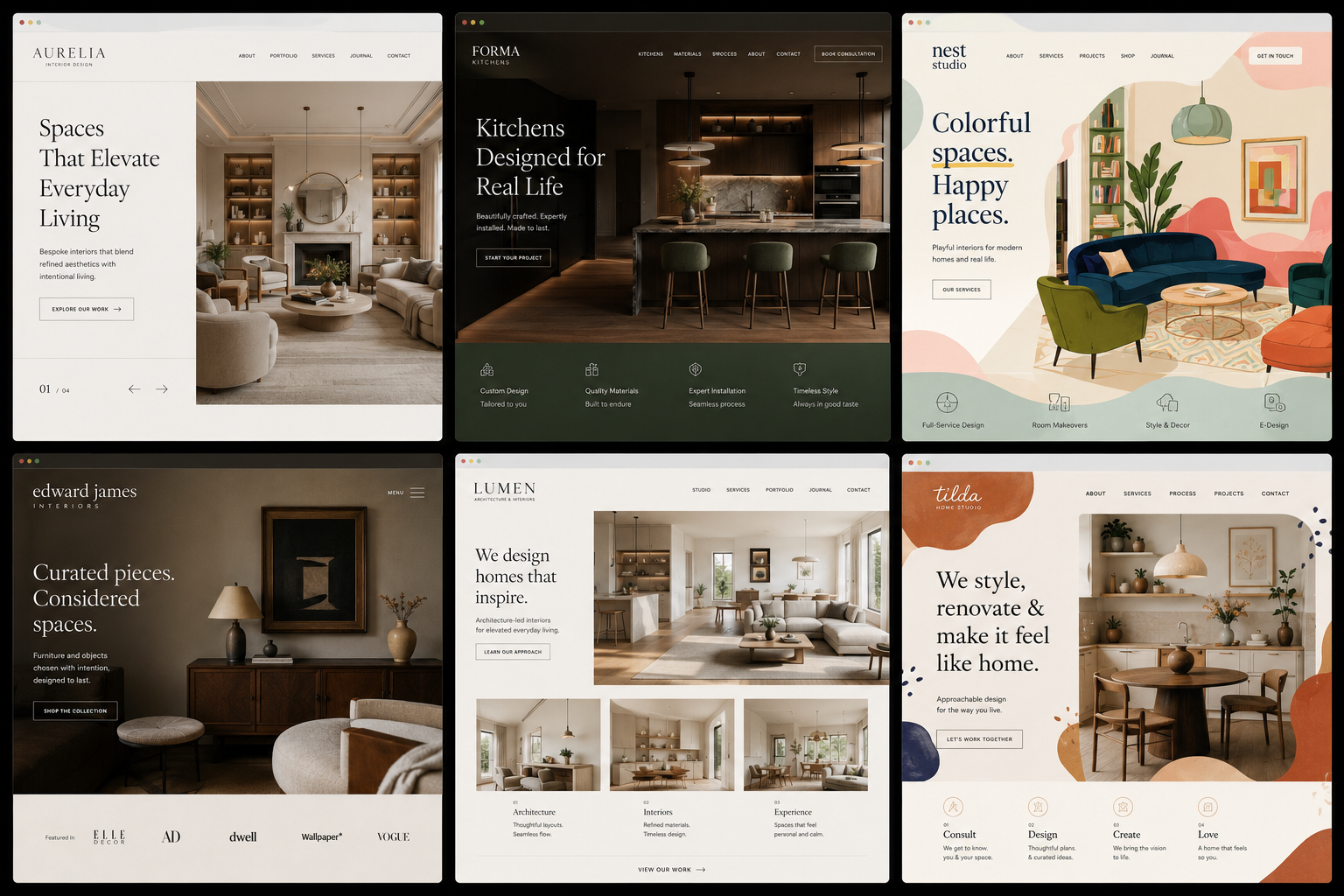
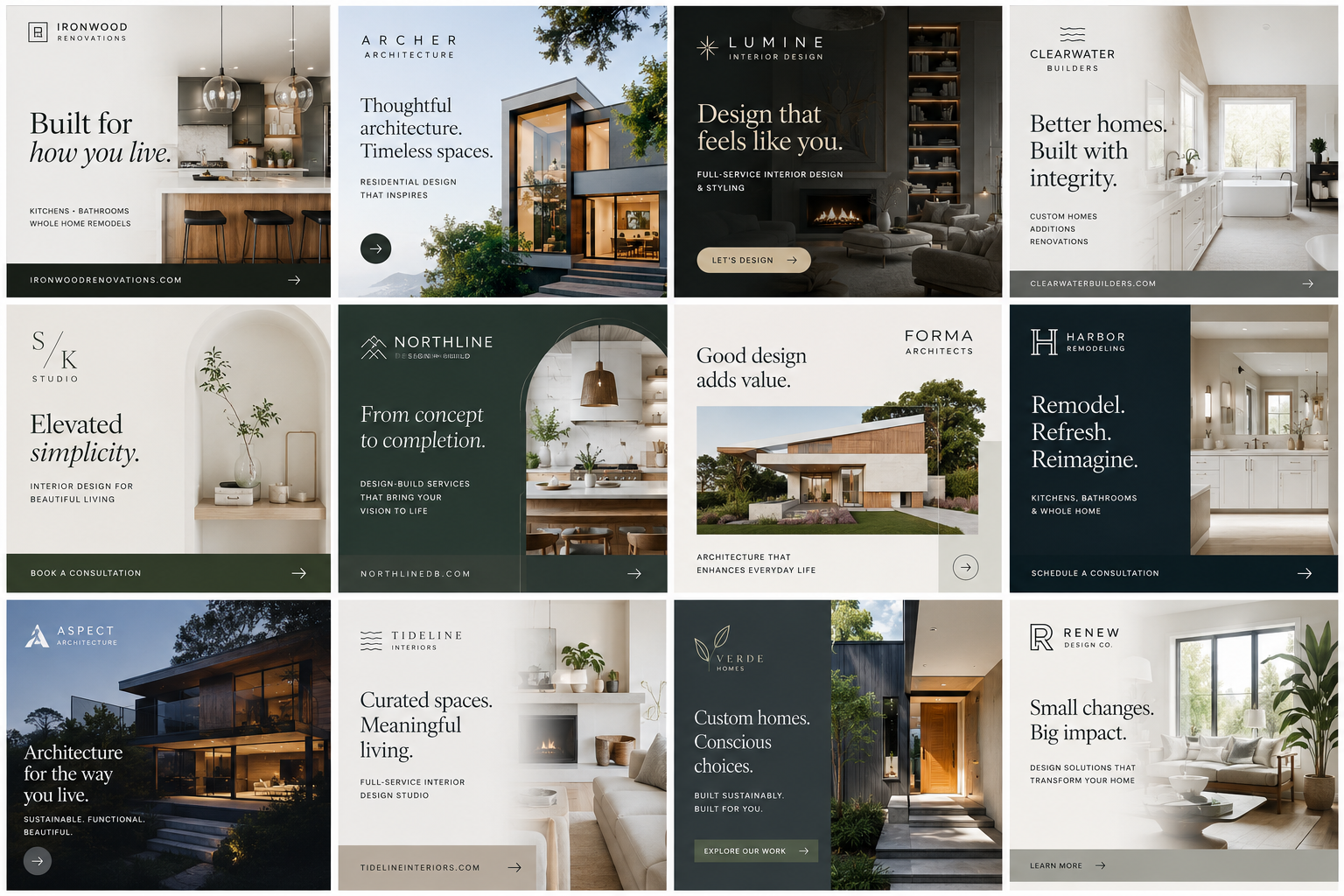
The visual system should make service pages and project proof feel organized, not generic. GYRO-style page sections could help homeowners scan by project type, city, challenge, outcome, and next step.
Fix the foundation first, then scale what works.
Now
Verify GA4, form events, calls, email clicks, CTA clicks, GBP data, and CRM lead fields. Watch whether inquiries are qualified, not just whether traffic rises.
Add project type, city, timeline, optional budget, upload, and referral source. Measure form completion and lead quality.
Map the core pages for custom homes, additions, renovations, decks, and garages. Use existing projects as proof.
Next
Start with custom homes and additions/renovations, then build garage/workshop and deck/outdoor living pages. Watch impressions, engagement, and inquiries by service.
Convert the Monument custom home, Downtown Monument renovation, Black Forest garage, deck rehab, or second-story addition into structured proof assets.
Standardize NAP/name details, update GBP after access is confirmed, and implement a post-project review/testimonial workflow.
Later
Add accurate LocalBusiness, service, FAQ, and project schema only after claims are confirmed.
Turn one project per month into website, GBP, social, FAQ, and sales-support assets.
Use paid search or local ads only after tracking and landing pages are stable, and judge results by qualified inquiries.
A sensible sequence for turning the audit into action.
First 30 days
Focus: Measurement, technical clarity, positioning, and conversion basics.
- Audit analytics, forms, calls, crawl health, sitemap, robots, and schema.
- Define priority services and project-fit criteria.
- Update the contact form and choose three flagship projects.
Success signal: Conversion events are working, service priorities are clear, and inquiries capture more useful context.
Days 31–60
Focus: Core service pages, local proof, and case-study structure.
- Publish priority service pages.
- Create structured case studies from existing project proof.
- Add proof and service-specific CTAs near conversion points.
- Build a meaningful Monument page and plan Black Forest or Tri-Lakes content.
Success signal: Pages are indexed, visitors engage with service content, and project-page CTAs begin to show measurable interest.
Days 61–90
Focus: Reputation, planning content, GBP activity, and repeatable distribution.
- Launch a review and testimonial workflow.
- Organize a process and planning hub.
- Repurpose one project into website, GBP, social, FAQ, and sales assets.
- Evaluate whether a narrow paid test is ready.
Success signal: Project assets publish consistently and lead-quality data is visible enough to guide next decisions.
Test practical improvements instead of guessing what will work.
Project-type CTA split
Hypothesis: Visitors convert more confidently when the CTA matches their project type.
Change: Use options such as custom home, addition, renovation, deck/garage, and “not sure yet.”
Qualified inquiry form
Hypothesis: Light qualification improves lead quality without discouraging serious prospects.
Change: Add project type, city, timeline, optional budget, upload, and referral source.
Proof near the form
Hypothesis: Relevant proof at the decision point increases contact confidence.
Change: Add a testimonial, credential note, and similar-project links beside the contact form.
Case-study CTA
Hypothesis: Project pages can generate inquiries, not just visual browsing.
Change: Add “Have a similar project?” CTAs after project summaries and galleries.
Planning guide fallback
Hypothesis: Early-stage visitors will engage with a guide before submitting a project inquiry.
Change: Offer a project timeline or planning checklist as a soft next step.
Mobile call path
Hypothesis: Mobile users with high intent may prefer calling over filling out a form.
Change: Test a sticky mobile Call / Request Consultation bar after tap-to-call tracking is confirmed.
Measure what creates good-fit project conversations.
The goal is not more traffic in isolation. The goal is to understand which services, pages, locations, and channels create qualified conversations that can become the right projects.
Leads that match service area, service type, project size, and timing.
Phone taps and attributable calls, especially on mobile and local pages.
Inquiries that become real conversations with enough context to evaluate fit.
Custom home, addition, renovation, deck, garage, or other project type.
Project city or area, including Monument, Black Forest, Tri-Lakes, Palmer Lake, and Colorado Springs.
Organic, direct, referral, GBP, social, paid, email, or other source.
New reviews and testimonials captured per quarter, with project context.
Qualified, unqualified, future opportunity, or not a fit — recorded in the CRM or lead sheet.
Make the work repeatable, not one-off.
For Clifford Joyner Construction, the opportunity spans brand clarity, website structure, service pages, project proof, local search, reviews, Google Business Profile activity, social repurposing, conversion tracking, and measurement. That is exactly the kind of interconnected work that benefits from a shared strategic source of truth.
A GYRO Master Organization Document could capture the company’s services, story, differentiators, proof, local relevance, voice, customer concerns, and best-fit project language. Megaphone could then help turn that source material into a coordinated organic marketing rhythm across the website, SEO, GEO, social content, GBP updates, reputation support, and ongoing refinement.
Clarifies services, positioning, local relevance, customer concerns, and proof points before content is produced.
Turns one completed project into case studies, service proof, FAQs, GBP posts, social content, and sales assets.
Connects marketing activity to qualified inquiries, calls, consultations, service requested, geography, and project fit.
What should be validated with internal access.
This audit is based on public information and an outside-in review. The main findings are still useful, but several important business and performance questions require internal access.
Google Analytics, Search Console, Google Business Profile management data, CRM data, lead quality, call data, form abandonment, close rates, revenue by service, ad accounts, source-code-level schema, full crawl results, and measured Core Web Vitals.
These gaps should not slow down obvious improvements. They should guide the first 30 days: confirm tracking, validate technical health, clarify business priorities, and then use real data to refine the roadmap.
The foundation is worth building on.
Clifford Joyner Construction already has the experience, local proof, and project depth that a strong construction marketing system needs. The next step is to organize that proof so the right homeowners can understand it, trust it, and act on it.
These recommendations can be implemented independently. GYRO can also help connect the work through a MOD and Megaphone so the website, search presence, project stories, local visibility, reputation, and measurement all move in the same direction.