
Inspire Kitchen Design Studio
A boutique, design-led Denver kitchen studio with real substance — a founder-led reputation, a working showroom, premium partners, and earned media — and a clear opportunity to turn those strengths into visibility, proof, and measurable inquiries.
The short version
TL;DR
A working showroom inside the International Design Collection building, a founder-led reputation, premium partners, and design-press features from 2016–2023 give the studio proof most small firms never assemble.
Key pages show both 720-650-0500 and 720-807-6835. Inconsistent contact details create friction for visitors and work against local discovery and trust.
Kitchen work is the clearest revenue driver, yet the kitchen page reads as persuasive general copy rather than a local landing page with projects, budget guidance, and FAQs.
Most calls to action are a generic "Contact Us." A specific next step — "Book a Kitchen Design Consultation" or "Schedule a Showroom Visit" — better fits a premium, considered purchase.
The showroom is a differentiator many competitors can't match. Tightening the local service-and-proof cluster around it is a defensible way to earn non-brand search demand.
Standardize contact details, sharpen the offer, strengthen the kitchen page, and install measurement — before spending on traffic acquisition.
Inspire isn't only competing with kitchen showrooms. In Denver's premium market it also competes with design-led renovation firms and luxury builders — Duet Design Group, Donna Mondi Interior Design, Ashley Scheidel Design Studio, Dream Homes Inc., and Cadre General Contractors among them — who reach the same affluent homeowner before that homeowner has even decided they want a "kitchen specialist." That makes message clarity and visible proof unusually valuable here.
Start from strength
What Inspire Already Has Going For It
Founder-led expertise that reads as credible
The About page centers a named owner and lead designer with more than two decades in the design industry, and the studio's published profiles describe deep combined design-and-installation experience. For a high-consideration purchase, a visible, experienced principal is a genuine trust asset.
A physical showroom as a differentiator
Inspire operates from a showroom inside the International Design Collection building — presented as a large, one-stop selection destination near downtown Denver. That turns the buying experience into a tactile visit rather than a purely digital consultation, which many competitors cannot match.
A clear "form + function" positioning
The brand consistently emphasizes design, function, and service — space planning, workflow, and tailoring each project to the client rather than forcing a house style. It's a commercially sound, differentiated stance for a design-led kitchen studio.
Earned media and a premium partner network
The Publications page shows features across Denver Design Week, Mountain Living, Colorado Homes & Lifestyles, and 5280 Home, dated from 2016 through 2023, alongside a partner ecosystem spanning cabinetry, appliances, stone, tile, and specialty resources. That's real third-party validation.
Clean, crawlable site structure with aligned titles
Page titles and headings generally match the studio's core services and city across the homepage, kitchen, bathroom, showroom, FAQ, blog, About, and contact pages. That title/heading alignment is a solid technical foundation to build on.
An active blog and a strong FAQ
The blog was still publishing into spring 2025 — a positive freshness signal — and the FAQ usefully addresses budgets, layouts, materials, and trends. The raw subject-matter for a strong local content system already exists on the site.
Who it's for
Market Position & Customer Fit
Current positioning
Inspire presents itself as a Denver kitchen design and remodeling studio, with kitchen work clearly primary and bathroom remodeling secondary. The language is luxury-coded and design-first, anchored by the showroom experience and a space-planning philosophy.
Likely best-fit customer
An aesthetics-driven homeowner pursuing a considered, higher-investment kitchen project — someone who wants expert guidance and a showroom to touch materials, not the lowest bid. Shelter-media features and the IDC showroom both reinforce this profile.
High-value services
Custom kitchen design and remodeling is the core commercial engine and positioning anchor. The showroom itself is a high-value, differentiating "service." Bathroom remodeling is a reasonable diversification but a weaker differentiator.
Customer concerns to answer
For a considered purchase, buyers worry about budget ranges, timeline, disruption, and whether the finished result will fit their life. The site touches these lightly in the FAQ but rarely resolves them on the pages where decisions are made.
Message-market fit
The message architecture is consistent and believable — a kitchen as a synthesis of design, function, service, and installation. The gap is that those claims aren't consistently converted into sharper, decision-stage proof: budget bands, neighborhoods served, before/after transformations, testimonials, and consultation expectations are largely absent from the pages where they'd do the most work.
Lean harder into what only Inspire can offer: a design-led Denver kitchen studio with a real showroom, an experienced principal, and published work — the specialist a homeowner visits to plan a kitchen properly, in person, with premium materials in hand. This sharpens the contrast against broader luxury designers and builders who can't offer the same hands-on, kitchen-first experience.
Why this market
A few verified market signals help explain why Denver is favorable ground for a design-led kitchen studio. Each is a snapshot from the sources noted during this review.
Metro Denver residents, after roughly 2.8% growth from 2020–2024 — a large, growing metro with active housing and project-planning needs.
National median kitchen-remodel spend in a 2025 industry trend summary — supporting premium consultation and budget-education content.
Year-over-year rise in home repair & remodeling costs (Q2 2025) — cost-conscious buyers reward firms that communicate process, materials, and value clearly.
When buyers feel cost pressure, the firms that win are usually the ones that make investment ranges, process, and value easy to understand up front — which is exactly the kind of content Inspire is well placed to own.
At a glance
Outside-In Marketing Scorecard
Consistent "form + function" story, a real showroom, and credible earned media.
Clean, crawlable, and aligned on titles — but shallow for winning broad non-brand demand.
Image-heavy showroom and publications pages warrant a formal speed review; not yet measured.
Good title/heading alignment; contact-detail inconsistency is the visible issue to fix.
Strong brand-term fit; the non-brand service-and-location cluster is thin.
Active blog and useful FAQ; publications read as an archive rather than a conversion asset.
A listing very likely exists; profile detail and citation consistency deserve a hands-on audit.
Editorial proof is strong; structured review capture and on-site display are underused.
Profiles are linked; much presence is tied to a personal brand rather than a distinct company identity.
Generic CTAs and limited on-page proof leave qualified inquiries on the table.
Without measurement in place, optimization decisions stay subjective. A first-30-days priority.
Clear services and location; entity consistency and third-party corroboration can be strengthened.
The detail
Detailed Digital Audit
Brand & messaging
Observed. The core message is consistent: a kitchen as a synthesis of design, function, service, and installation, with the principal framed as a space-planning expert who tailors each project to the client. Why it matters. That's commercially sound for a design-led studio, but the pages lean on brand assertions and generic calls to action instead of decision-stage proof. What's next. Bring project examples, budget context, and consultation expectations onto the service pages so the message is shown, not just stated.
Website structure & user experience
Observed. The top-level map is clean and crawlable: Home, Kitchen Design, Bathroom Remodel, three style pages, About, Publications, Showroom, Trusted Partners, FAQ, Blog, and a Visit/Contact page. Why it matters. That's tidy for a small firm, but shallow for a local service business trying to win broader non-brand demand. What's next. Deepen the highest-value service pages and add a genuine local service-and-proof layer beneath the current structure.
| Page | What works | What limits it | Depth |
|---|---|---|---|
| Home | Clear geographic qualifier, style-led imagery, concise core promise, visible CTA | Minimal proof above the fold; limited conversion specificity; little service segmentation | Competitive |
| Kitchen Design | Strong service/city/heading alignment; explains layout, materials, and the value of a designer | Reads as persuasive general copy; lacks project examples, FAQs, budget context, testimonials on-page | Developing |
| Bathroom Remodel | Explicit process outline and project-management framing | Less differentiated than kitchen; also lacks proof modules and local architecture | Developing |
| About | Strong founder story; clear design tenure | Limited broader team visibility; no deep "why choose us" proof grid | Competitive |
| Publications | One of the best pages; third-party validation dated 2016–2023 | Functions like an archive; not integrated into service-page persuasion | Strong |
| Showroom | Tangible destination, appointment framing, large visual gallery | Heavy image presence likely adds page weight; still uses generic CTA language | Strong |
| FAQ | Useful on budgets, layouts, materials, and trends | Broad questions; no structured FAQ-to-lead path such as a guide or planner | Competitive |
| Blog | Posting continued into 2025; topics match buyer questions | An analytics-style byline may weaken perceived authorship trust if unexplained | Competitive |
| Contact / Visit | Dedicated page with address, email, phone, and form | Generic offer; no project-fit qualifiers or clear response-time expectation | Developing |
Website performance
Measured page-speed results (Core Web Vitals) could not be captured during this outside-in review, so we're not going to guess at numbers. What we can say qualitatively: the showroom and publications pages are visibly image-heavy, and the showroom page in particular loads a long run of image assets. That doesn't prove slowness, but it's exactly the kind of pattern that rewards image optimization, lazy-loading, and a mobile-rendering check.
These galleries and hero images are both the heaviest assets and the most persuasive ones — which is precisely why they deserve optimization rather than removal. Establishing measured speed baselines belongs in the first 30 days, so that later changes can be judged against real data instead of impressions.
Technical SEO
Observed. The strongest signal is title and heading alignment — pages generally match their core service and city. The clearest issue is contact-detail consistency on the site itself: key pages show two different phone numbers (720-650-0500 and 720-807-6835), and the footer and contact page don't agree. Why it matters. Consistent name, address, and phone details underpin local discovery and consumer trust; mismatched numbers create confusion for visitors and for the directories and profiles that reference the business. What's next. Choose one canonical phone number and apply it everywhere — site, profile, directories, and social bios.
The two-phone-number issue is the single fastest trust-and-local-search win available. It's low effort, entirely within your control, and worth resolving before any traffic-acquisition work begins. Meta descriptions, canonicals, robots directives, schema, and sitemap exposure weren't fully verifiable from the outside and are worth confirming directly during implementation.
Organic search visibility
Observed. Inspire's titles and headings fit its brand and core kitchen terms well, and the showroom page is a real non-brand differentiator. A precise, localized ranking sample and search-volume data were not publicly verifiable during this review, so the read here is directional and about content architecture rather than tracked positions. Why it matters. The studio has enough raw subject-matter to support a strong local cluster — kitchen design, kitchen remodeling, showroom visits, materials comparisons, and cost/process education — but those ideas are currently spread across generic service copy and unstructured blog posts instead of a tighter service-and-proof framework. What's next. Consolidate the cluster around a proof-rich kitchen cornerstone page, a showroom page that converts, and a small set of genuinely differentiated supporting pages.
Content architecture & freshness
Observed. The blog showed posts into spring 2025, while the publications page carries dated features through 2023. Why it matters. That means the site isn't abandoned — a genuine positive — but there's a split between actively published SEO content and a more static portfolio/publication archive. Freshness is a momentum and trust signal, not a vanity metric. What's next. Bring the publications and project work forward as living proof on the pages that sell, and keep a steady, modest publishing cadence rather than sporadic bursts.
Local search & Google Business Profile
Observed. The site links to Google Maps/business destinations from the homepage and footer, which strongly suggests an active listing. Review counts, categories, photo recency, and response behavior were not publicly verifiable from the outside during this review. Why it matters. For a design studio, the profile is often where a referred or high-intent buyer forms a first impression, so its completeness and consistency directly affect inquiries. What's next. Claim/verify the profile and confirm categories, services, photos, and a review-request workflow.
Beyond Google, the platforms that matter most for this vertical — Houzz especially — should be audited directly. The site links to a Houzz profile and to design-community destinations, but public profile metrics weren't retrievable from the outside. Yelp and Pinterest presence could not be confirmed during this review; if absent, Pinterest in particular is a natural fit for a visual, design-led studio.
Reviews, reputation & the customer's voice
Observed. A full public review-sentiment picture wasn't retrievable during this review, so we're not going to represent counts or ratings we couldn't verify. What is consistent across the studio's own pages and its earned media is the language customers and editors use — and that language is a gift for sharper website copy.
Themes to amplify
- Form and function. The dynamic between beauty and everyday usability recurs across the About copy and design-press features.
- Space planning. The principal is described as a space-planner at heart — a real differentiator versus generic remodelers.
- Unique to the client. Projects are framed as tailored to each homeowner's personality and functional needs.
- One-stop shopping. The showroom is positioned as a single place to see and select everything.
- Luxury with innovation. Premium design language that's best balanced with warmth and clarity.
What to do with it
- Use the customers' own words in hero copy, service intros, and consultation framing — it converts better than agency phrasing.
- Turn "space planning" into a named, visible part of the process rather than an implied trait.
- Build case-study narratives around "unique to the client" so proof reinforces the promise.
- Put structured review capture in place so future sentiment is verifiable and displayable, not anecdotal.
Direct competitor review mining was limited during this review, so we're not attributing specific praise or complaint themes to named competitors. The practical takeaway stands on its own: in a category where referral visitors check profiles before they call, a firm with visible, current reviews looks more active and trustworthy — which is reason enough to make structured review capture a near-term priority.
Portfolio, social & visual content
Observed. Inspire clearly has a presence beyond its own site — links out to Google, Houzz, Facebook, and Instagram, plus a LinkedIn presence. During this review, much of that presence was either not publicly extractable or tied to a personal profile (the LinkedIn link resolves to a personal profile, which showed roughly 6,000 followers at the time we looked) rather than a distinct company identity. Why it matters. Routing social presence through a personal brand isn't wrong, but it makes brand governance, reporting, and entity consistency harder over time — and it leaves the company's own visual story underbuilt on the platforms where design buyers browse. What's next. Establish clear company profiles on the highest-value visual platforms and feed them from a repeatable project-to-content workflow.
The fastest way to fix the visual gap is to stop thinking one project = one post. A single completed kitchen can become a website case study, a short before/after social sequence, a reel, a profile post, an FAQ answer, service-page proof, a local-search asset, and a sales-conversation aid. Inspire already produces the raw design material; what's missing is the repurposing habit.
Analytics & measurement readiness
Observed. From the outside, we can't confirm what analytics, tag management, call tracking, or form-event tracking is in place — and we won't assume its absence. Why it matters. Without clear measurement, every optimization decision stays subjective, and it's impossible to tell which pages and sources actually produce qualified inquiries. What's next. Confirm and, where needed, configure analytics, search-performance data, call tracking, and form-event tracking so that the improvements in this review can be judged by results. This is a first-30-days item.
AI-search & GEO readiness
Observed. AI-assisted search systems reward clarity and corroboration: a clear statement of what a business does, where it operates, which services it's known for, who it serves, and third-party sources that agree. Inspire is clear on service and location, but two things work against clean entity understanding — the inconsistent phone numbers on its own site, and social presence routed through a personal profile rather than a distinct company entity. Why it matters. GEO isn't a trick; it's the natural payoff of consistent, well-corroborated information. What's next. Standardize the entity details, strengthen third-party corroboration (profile, directories, earned media presented as proof), and make sure the site answers the buyer questions people actually ask.
Turning visits into inquiries
Conversion & Customer Journey Review
Above-the-fold first impression
Within the first screen, the homepage does convey what the business does and where — a clear geographic qualifier and style-led imagery land quickly. What a first-time visitor can't easily tell in those first five seconds is why to trust this studio over the alternatives and exactly what to do next: proof is minimal above the fold, and the primary action is a generic contact link rather than a specific, valuable next step. On the image-heavy pages, that first impression also depends on load speed, which is why the performance baseline matters.
Offer strength
The dominant calls to action across the site are "Contact Us," "Visit," and generic showroom links. There's no publicly visible named offer — no "Book a Showroom Consultation," "Schedule a Design Discovery," or "See Recent Denver Kitchens." For a premium, long-consideration purchase, a generic contact link doesn't reduce friction or clarify what happens next.
Denver's premium design-led competitors — the interior-design and renovation firms Inspire is measured against — typically lead with consultation-style engagements and portfolio-forward experiences rather than a bare "contact us." Inspire's showroom is a genuinely stronger hook than most can offer; the opportunity is simply to name and frame it as a concrete next step, so the studio's real advantage shows up in the call to action itself.
Mid-funnel offer
There's no visible resource for a not-yet-ready visitor — no lookbook, budget guide, kitchen planner, or checklist. In a category with long consideration cycles, that's a missed chance to capture interest early. The blog and FAQ already contain the raw material (a kitchen remodel checklist, budget and material guidance) to package one strong lead magnet.
Conversion paths & friction
The realistic path from most pages to an inquiry runs through a generic contact form or a phone number that isn't consistent across pages. Portfolio and showroom pages carry strong visuals but lean on the same generic calls to action, and there's no clear on-page path from "I'm inspired" to "here's the specific next step." Resolving the phone inconsistency and adding a named, reassuring offer removes the two biggest sources of friction at once.
Trust-gap inventory
| Trust component | Status | Recommended improvement | Priority |
|---|---|---|---|
| Process explanation | Present | Make it visual and specific to a kitchen project, with timeline context | Medium |
| Before/after evidence | Weak | Add project transformations on the kitchen and showroom pages | High |
| Client testimonials near CTAs | Missing on-page | Place short, specific quotes beside conversion points | High |
| Budget guidance | Light | Add an investment-range explainer so buyers self-qualify | High |
| Consultation expectations | Weak | State what happens next and expected response time | Immediate |
| Credentials & earned media | Strong | Surface "Featured In" proof on service pages, not just Publications | Medium |
| Team visibility | Partial | Introduce the wider team/roles beyond the founder | Later |
| Contact consistency | Needs attention | One canonical phone number everywhere | Immediate |
Lead quality & form friction
The contact form is serviceable but generic. For a premium studio, a little more qualification actually improves lead quality without much added friction: project type (kitchen vs bath), rough scope or budget band, service-area confirmation, and desired timeframe help the team prioritize and prepare. Pair that with a clear response-time expectation, a confirmation of what happens after submission, and a testimonial near the form, and both conversion rate and lead quality tend to improve together. The one caution: add qualification in small, optional steps so it never feels like an interrogation.
Three customer journeys
- Needs
- To confirm the studio is real, current, and credible after a recommendation.
- Current friction
- Inconsistent contact details and a personal-profile social presence can make the brand feel less "buttoned-up" than it is.
- Fix
- Standardize contact details and surface earned media + reviews on brand and service pages.
- Primary action
- Book a consultation / showroom visit.
- Best proof
- Publications and the showroom.
- Needs
- To quickly compare providers on proof, process, and fit.
- Current friction
- Service pages read as general copy without projects, budget context, or testimonials.
- Fix
- Build a proof-rich kitchen cornerstone page with examples, process, budget guidance, and FAQs.
- Primary action
- Request a kitchen design consultation.
- Best proof
- Before/after projects and a clear process.
- Needs
- Ideas and reassurance before they're ready to talk to anyone.
- Current friction
- No mid-funnel offer to capture early interest; galleries end in a generic call to action.
- Fix
- Add a lookbook, budget guide, or kitchen planner as a low-commitment next step.
- Primary action
- Download the guide / join the list.
- Best proof
- Showroom imagery and material curation.
Conversion readiness by page
| Page | Conversion job | Readiness | Most valuable single improvement |
|---|---|---|---|
| Home | Orient & route | Competitive | Add above-the-fold proof and a named primary offer |
| Kitchen Design | Convert high intent | Developing | Turn it into a proof-rich cornerstone with projects, budget, FAQs |
| Showroom | Differentiate & book visits | Competitive | Replace generic CTA with "Schedule a Showroom Visit" |
| Contact / Visit | Capture the inquiry | Needs attention | Add light qualification + response-time expectation |
| Bathroom Remodel | Convert secondary intent | Developing | Add proof modules and clearer differentiation |
The field
Competitive Benchmark
| Firm | Positioning & emphasis | Contrast with Inspire |
|---|---|---|
| Dream Homes Inc. | Denver kitchen & bath plus large-scale renovations; full construction oversight; aging-in-place angle; active since 1999 | Stronger full-home renovation positioning; Inspire has a stronger showroom / kitchen-specialist identity |
| Duet Design Group | Denver residential renovation and new construction for affluent clients; collaborative, logistics-heavy model | Broader interior-design positioning; Inspire is more explicitly kitchen-led and material-selection focused |
| Ashley Scheidel Design Studio | Denver design firm; timeless interiors, natural materials, new construction and renovations | Similar premium audience; Inspire can differentiate with the showroom and kitchen specialization |
| Cadre General Contractors | Colorado luxury-home builder; custom homes, broad style range, close architect/designer collaboration | Construction-led; Inspire is more boutique, design-led, and approachable for kitchen-first projects |
| Donna Mondi Interior Design | Denver office; architecturally driven luxury interiors, multi-market high-end positioning | Competes for premium interiors attention; Inspire has stronger local kitchen specialization but narrower brand reach |
Most of these firms are generalists competing for the whole luxury renovation budget. Inspire is the specialist a homeowner can visit to plan a kitchen properly — in person, with premium materials in hand, guided by an experienced designer. That's a distinct, defensible position. The reason it doesn't win more often isn't the offer; it's that the offer isn't packaged, proven, and distributed as forcefully as the generalists package theirs. Close that gap and the specialization becomes an advantage rather than a well-kept secret.
Where to build
Search, Content & Authority Opportunities
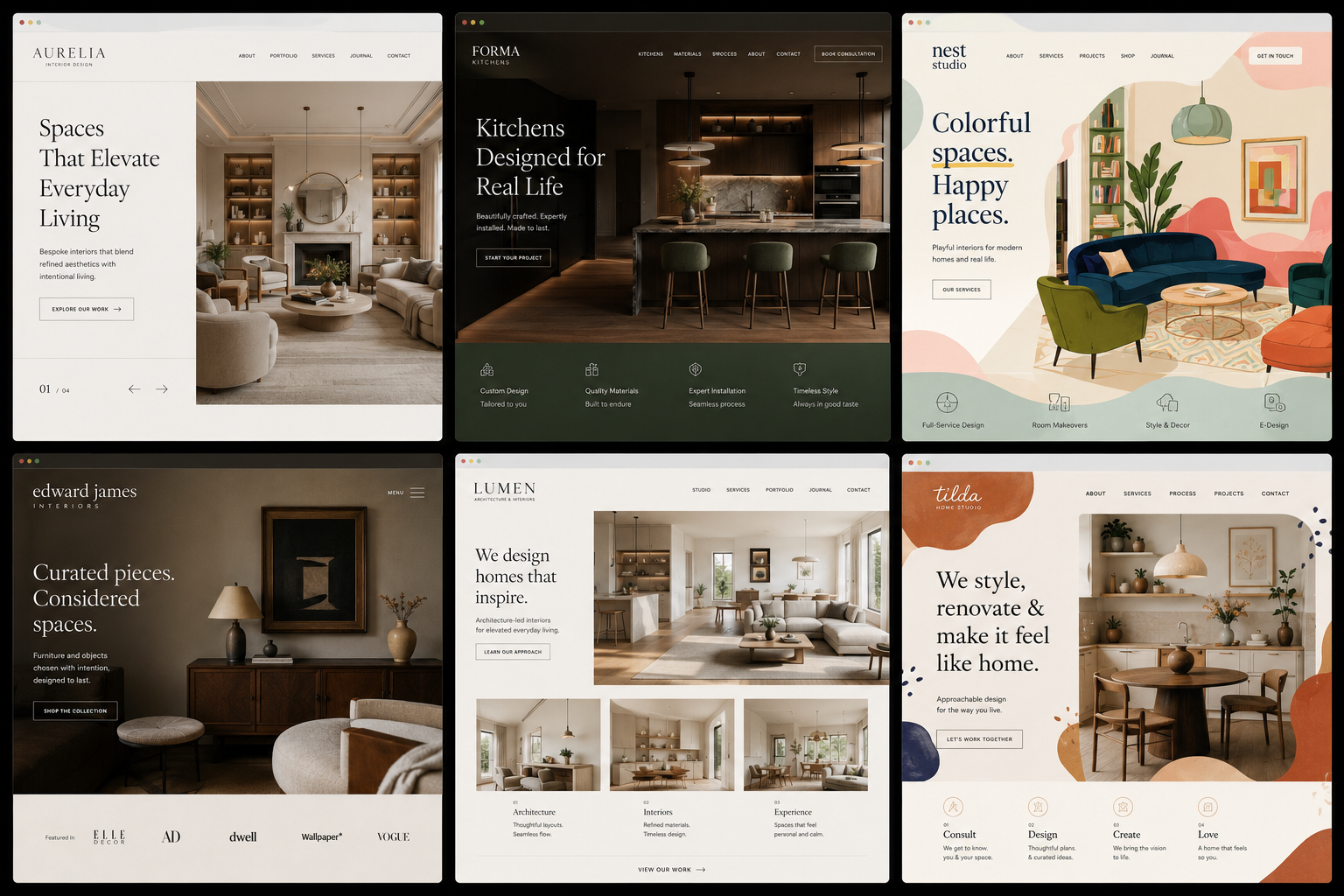
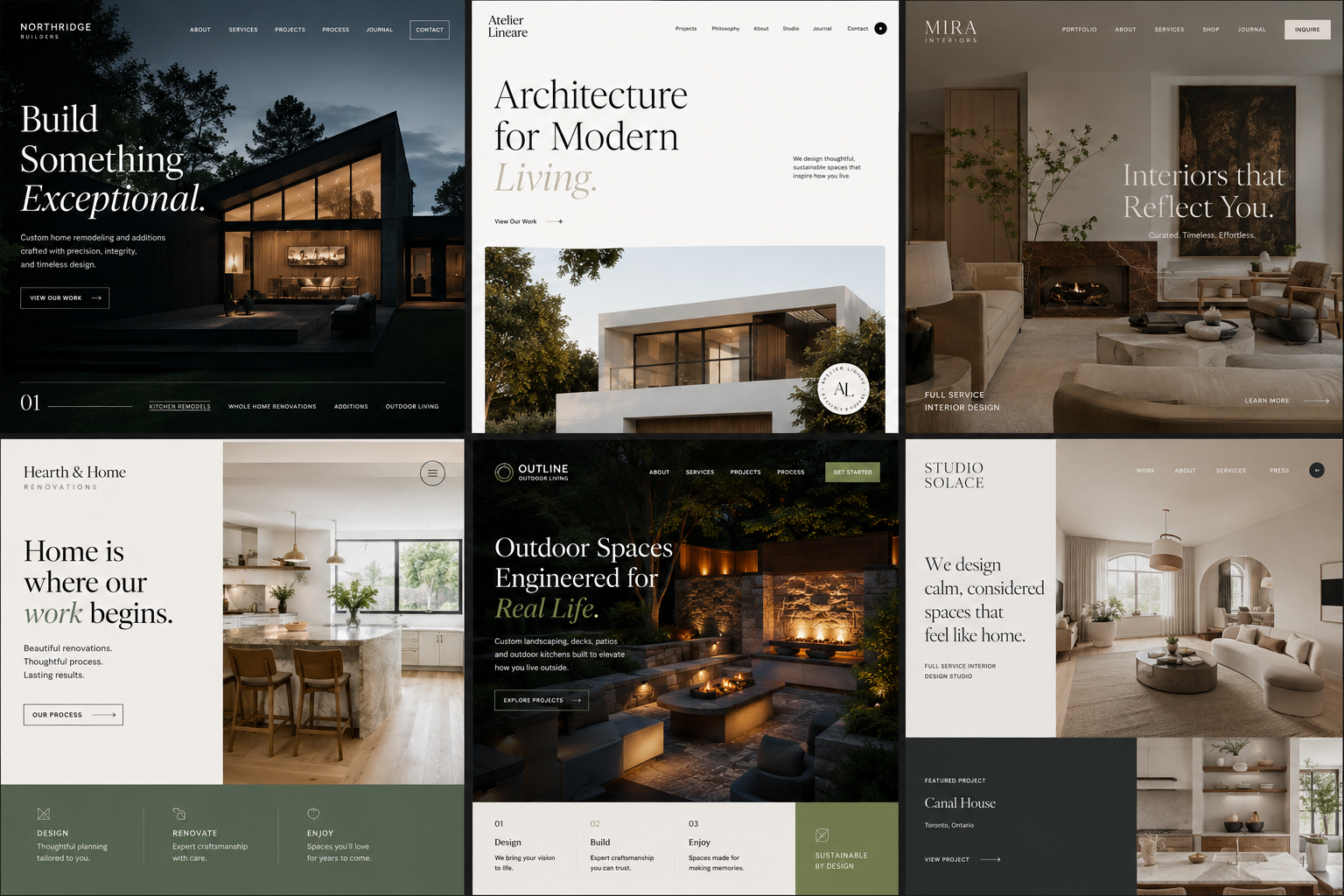
A note on location pages: the goal is a tighter, genuinely differentiated cluster — not mass-produced near-duplicate city pages. Every location or service asset should have a legitimate reason to exist and something specific to say. Below is the kind of visual direction that helps a service page carry proof and personality rather than reading as generic copy.
In priority order
Recommended Action Plan
Now — foundational & urgent
Choose one canonical phone number and email policy and apply it across every footer, header, contact block, profile, directory, and social bio. Likely effect: the fastest trust and local-search win available. First step: pick the number and update the site. Watch: one consistent number visible everywhere.
Replace generic "Contact Us" with a specific, valuable next step — "Book a Kitchen Design Consultation" or "Schedule a Showroom Visit" — and say what happens next. Likely effect: a clearer, lower-friction path for premium buyers. First step: rename the primary CTA and add a short "what to expect" line. Watch: consultation request rate.
Confirm/configure analytics, search-performance data, call tracking, and form-event tracking with source attribution. Likely effect: decisions move from instinct to evidence. First step: audit what's already in place. Watch: qualified inquiries by source; conversion rate by page.
Next — conversion & authority
Expand the kitchen page with project examples, process, budget guidance, FAQs, neighborhoods, and publications. Likely effect: a stronger landing experience for high-intent search visitors. First step: assemble 3–5 recent projects. Watch: organic landings and consultation requests from the page.
Create a "Featured In" strip and 3–5 mini case studies drawn from existing projects, placed on service pages. Likely effect: credibility works where decisions are made. First step: build the "Featured In" strip. Watch: service-page engagement and assisted conversions.
Verify categories, services, and photos, and put a review-request workflow in place. Likely effect: a more active, trustworthy first impression for referral and local visitors. First step: claim/confirm profiles and set a review cadence. Watch: review count growth; profile actions.
Publish cost/budget, process, and materials pages that capture earlier-phase demand. Likely effect: earlier engagement and better-qualified inquiries. First step: ship the cost/budget explainer. Watch: organic entrances to info pages; assisted conversions.
Later — scaling & expansion
Monthly cadence: one project becomes a case study, a reel, a profile post, an email, and a blog excerpt. Likely effect: compounding proof and distribution. First step: pick one project and run it through the full repurposing set. Watch: posts per month; project-page views; assisted inquiries.
Launch a small test only once the new offer, tracking, and proof modules are live. Likely effect: paid amplifies a stronger system instead of compensating for a weak one. First step: confirm the foundation is in place. Watch: cost per qualified inquiry.
A sensible sequence
Practical 90-Day Roadmap
Key actions
- Standardize contact details site-wide
- Rename the primary offer & add "what to expect"
- Confirm/configure analytics, call & form tracking
- Establish measured page-speed baselines
- Claim/verify the business profile
Success signals
- One consistent phone number everywhere
- Tracking live; baseline metrics captured
Watch out for
- Don't start paid or heavy content before tracking is live
Key actions
- Ship the proof-rich kitchen cornerstone page
- Add "Featured In" + 3–5 mini case studies
- Add on-page testimonials near CTAs
- Add light form qualification + response-time note
- Start the review-request workflow
Success signals
- Cornerstone page live with real projects
- First new reviews arriving
Dependencies
- Tracking from phase one; project assets gathered
Key actions
- Publish cost/budget & materials education pages
- Package one lead magnet from existing content
- Stand up company profiles on visual platforms
- Run one project through the full repurposing set
- Review results; plan a narrow paid test if ready
Success signals
- A steady, modest publishing cadence
- Assisted inquiries traceable to new content
Risks or cautions
- Only consider paid once the foundation is proven
Because measured performance and profile details couldn't be confirmed from the outside, establishing those baselines is deliberately placed in the first 30 days — everything downstream is easier to judge once they exist.
Learn by testing
Conversion Experiments
Each test is framed as a question to answer, not a guaranteed winner — the point is to let real data decide.
Measure what matters
Measurement Plan
| KPI | What it means | How to track | Why it matters |
|---|---|---|---|
| Qualified inquiries | Forms/calls from prospects matching service area and project type | Analytics events, form fields, call tracking, CRM tagging | The core business outcome |
| Consultation bookings | Scheduled showroom visits or design consultations | Scheduler or form-to-calendar workflow | Better signal than raw lead count |
| Inquiry-to-consultation rate | Share of leads that become scheduled conversations | CRM stages | Reveals lead and follow-up quality |
| Landing-page conversion rate | Conversion on kitchen, bathroom, showroom, contact pages | Analytics + thank-you event tracking | Shows which pages actually sell |
| Profile actions | Calls, directions, website clicks, messages from the listing | Business-profile insights | Critical for local demand capture |
| Review velocity | New reviews per month and response rate | Profile insights / manual log | A trust-building proxy |
| Organic entrances by page | Sessions landing first on specific service/education pages | Analytics + search-performance data | Tells which content attracts demand |
| Branded vs non-branded clicks | Search demand for the name vs the category | Search-performance data | Measures growth beyond referrals |
| Qualified lead by source/medium | Organic, direct, referral, social, paid, partner | Analytics / CRM | Needed for budget allocation |
The throughline: measure the pipeline, not just the visits. Once these are in place, the recommendations in this review stop being opinions and start being testable — and the studio can invest where the evidence points.
Making it repeatable
Where GYRO & Megaphone May Help
Inspire already has the substance — a showroom, a recognizable founder, premium partners, and earned media. What's missing is the operating system that keeps those assets working together. Megaphone, GYRO's coordinated organic marketing system, is well suited to that job. A few natural connection points stand out:
A single source of truth (the MOD)
A Master Organization Document could capture the studio's services, story, differentiation, customers, proof, and voice in one place — so the site, profiles, and content all speak consistently and entity signals finally agree.
A content system from real projects
Megaphone could provide the operating system for turning one completed kitchen into a case study, social sequence, profile post, and service-page proof — the repurposing habit the studio is missing today.
Website, search, local & reputation together
Connecting website content, SEO and AI-search visibility, profile activity, and review capture in one coordinated effort could help make local visibility and trust improvements repeatable rather than one-off.
Conversion & measurement built in
With analytics, clearer offers, and steady refinement wired into the same system, the studio could keep improving from evidence — and see which work actually produces qualified inquiries.
How to read this
About This Review
We reviewed Inspire Kitchen Design Studio the way a prospective customer or a search engine would: from the outside, using what's publicly visible. Searches, profiles, and observations reflect samples and snapshots taken during the review window, and anything that changes over time — review counts, followers, search positions, page speed — should be read as a point-in-time look rather than a tracked figure.
A few things were not publicly verifiable from the outside and would be worth confirming directly: measured page performance, live profile details and review counts, and the current analytics setup. That's normal for an external review, and it points to the natural next step rather than a limitation in the findings.
The picture gets sharper with internal access: website analytics and search-performance data, CRM and call data, lead quality and close rates, revenue by service, business-profile manager access, any ad accounts, and a little customer research. With those in hand, the directional findings here become measured ones — and the priorities can be tuned to what's actually producing qualified inquiries. Think of it as an invitation to go deeper, not a caveat that weakens what's already clear.
A practical next step
You've built something worth amplifying
Inspire Kitchen Design Studio already has the showroom, the founder story, the partners, and the published work. The opportunity is to package and distribute those strengths so more of the right Denver homeowners find them — and to measure what works. Every recommendation here can be tackled independently; GYRO can help connect the pieces into one coordinated system through a Master Organization Document and Megaphone.
The next step isn't a commitment — it's a conversation about which of these moves would matter most for your studio right now.