
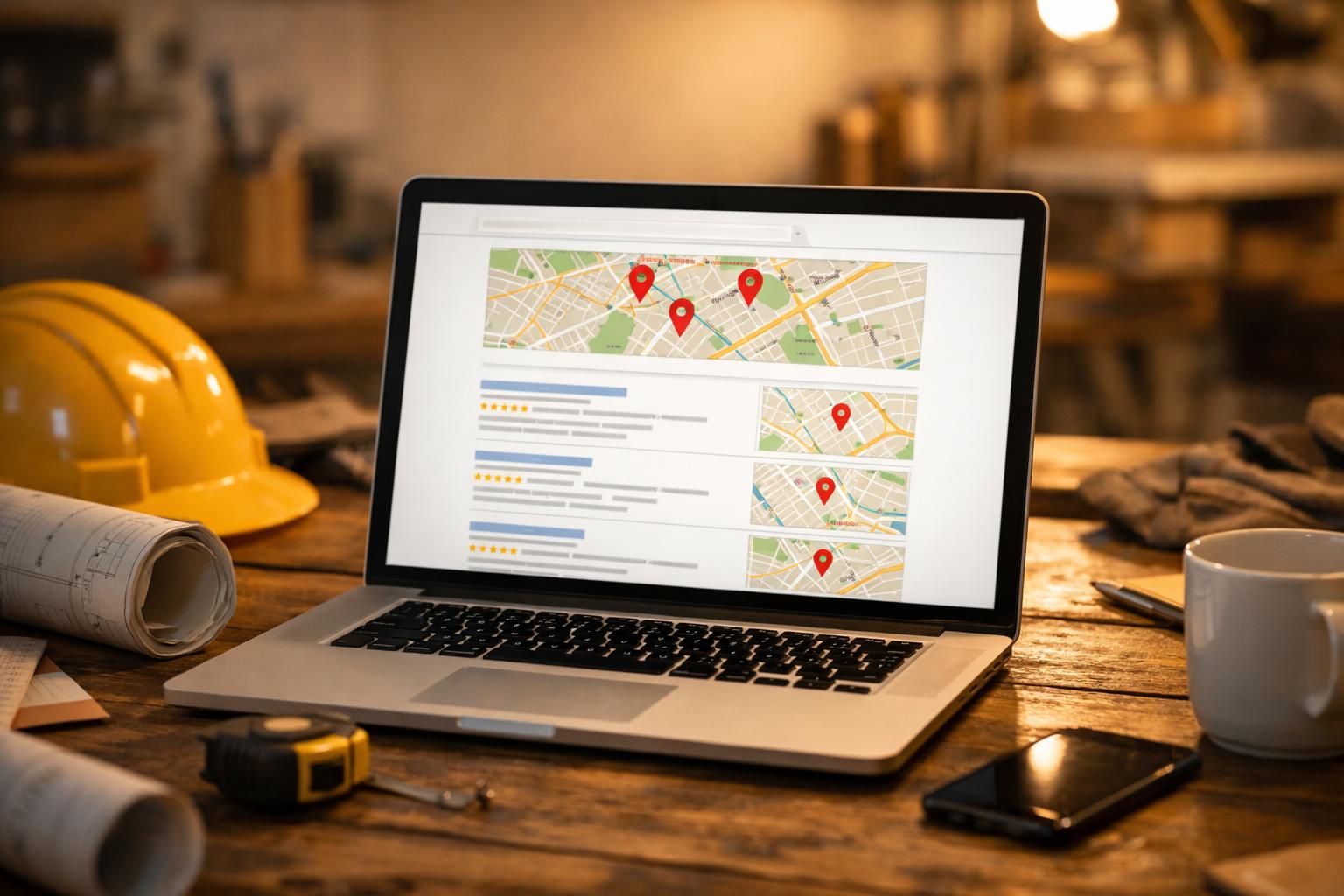
Local SEO for Remodelers
What local SEO tactics actually move the needle for remodelers competing for 'near me' searches.
Local visibility tied to real service coverage
When a homeowner searches for a remodeler near them, does Google see the same business your best clients already know?
Across the U.S., local SEO for remodelers works when your Business Profile, website, service area, project proof, reviews, and local references describe one accurate outfit. It is not a matter of adding every city, posting every week, or reaching a certain review count. Google says local results are mainly based on relevance, distance, and prominence. You can strengthen the facts and proof around the business, but you cannot buy distance or demand a map position.
Here is what I would do first: define the work and geography your crew can actually serve, make the profile accurate, choose the category that best describes the core business, connect it to a website that proves the same services, document projects with useful local context, and build an honest review process into closeout. Then measure profile activity, website actions, and lead fit separately. The goal is not to appear everywhere. It is to become the clearest credible choice in the markets that fit your job schedule.
Why does local SEO matter when your next job comes from a defined service area?
Most remodeling companies do not need national visibility. You need the right homeowner in a practical service area to find the business when a kitchen, bathroom, basement, addition, or whole-home project becomes real.
That service area is not just a marketing setting. It affects crew travel, supervision, supplier coordination, project size, client communication, and the job schedule. A lead two hours away may look valuable in a report and still be a poor fit for production. A closer project may be the better opportunity even when the search volume looks smaller.
Local search also happens at a high-trust point in the homeowner’s decision. The person may see a map result, compare categories and reviews, open project photos, click the website, read a service page, study a similar project, and then decide whether to call. Each step has to confirm the last one.
If the Business Profile says kitchen remodeling but the website leads with general repairs, the story breaks. If the profile lists a broad service area but the site cannot show any work, process, or local relevance outside the home market, the claim feels thin. If the website shows excellent projects but the profile has old hours, weak photos, or an inaccurate category, the homeowner may never reach the proof.
This is why I treat local SEO for remodeling companies as a connected operating system. The profile earns attention. The website carries the decision. Reviews and local references support trust. Your own pipeline tells you whether the attention became a right-fit consult.
Straight talk: local SEO does not expand your crew’s practical service area. It makes the business easier to find and evaluate inside the areas you can actually serve.
Local visibility should match the outfit you are building
An owner-operator may want a tighter market and fewer wasted drive hours. An established design-build firm may want to move toward larger projects in selected communities. A newer outfit may need to prove one core service in one primary market before adding more pages. The strategy should follow that business decision.
Write down the priority service, the secondary services, the true service area, the markets you are considering, and the work you will decline. That simple scope keeps profile edits, page creation, project documentation, and review requests from pulling in different directions.
What actually affects local-pack visibility for a remodeler?
Google describes three main local factors: relevance, distance, and prominence. They are simple words, but each one changes what you should do.
How well does the business match the search?
Complete business information, the right primary category, accurate services, a useful website, and project proof help Google and homeowners understand what the outfit does. Relevance is not created by repeating a phrase. It comes from consistent facts and useful detail.
How far is the business from the searcher?
Search location matters. A rank seen from the office may differ from a rank seen across town. Adding a service area does not remove distance from the calculation, and no provider can guarantee visibility throughout a listed area.
How established does the business appear?
Reviews, links, mentions, and information across the web can support prominence. The work should come from real customer experiences, useful project proof, local relationships, and legitimate references—not purchased review sentiment or manufactured links.
Most local SEO work improves the inputs you can control. Verify the profile. Keep the business information accurate. Select the most specific available primary category that describes the core business. Use a small number of relevant additional categories rather than a category for every service. Add useful photos and respond to reviews. Make the website explain the same services and markets.
What you cannot control is equally important. You cannot pay Google for a better organic local ranking. You cannot force the business to appear at the same position from every neighborhood. You cannot create a fake office or duplicate profile simply to look closer. You cannot guarantee that a service-area setting will make the profile visible in every listed city.
| Local-search layer | What you can control | Evidence to review | What it does not guarantee |
|---|---|---|---|
| Business eligibility | Accurate business model, real location or service-area setup, one profile per legitimate business location, and correct address handling. | Profile verification, real-world business information, staffed-location status, and published guidelines. | Approval forever, immunity from reverification, or a ranking position. |
| Category and services | The most specific primary category available, relevant additional categories, accurate services, and clear descriptions. | Current profile settings, real service mix, website pages, and sales qualification language. | Visibility for every service, city, or search phrase. |
| Service area | Specific areas that reflect where the outfit actually travels and works. | Crew travel, project mix, supplier logistics, job schedule, profile areas, and website coverage. | Ranking throughout the entire listed area or overcoming distance. |
| Website relevance | Service pages, project stories, local context, internal links, mobile use, and a clear contact path. | Indexed pages, page purpose, project proof, service-area consistency, and contact completion. | A map-pack position simply because a city name appears on a page. |
| Reviews | A consistent request process for eligible customers, honest responses, and closeout follow-up. | Request timing, customer eligibility, published reviews, response quality, and policy compliance. | A fixed review count, rating, or velocity that guarantees ranking. |
| Prominence and authority | Useful project resources, legitimate local relationships, association involvement, supplier collaboration, and earned references. | Public mentions, crawlable links, project features, directories, and Search Console’s link sample. | That every mention passes ranking value or creates a lead. |
| Measurement | Profile performance review, website analytics, call notes, form records, source fields, and pipeline disposition. | Views, clicks, interactions, inquiries, service-area fit, project type, consults, bids, wins, and losses. | That every profile action is a qualified lead or that one channel caused the result alone. |
Source basis: Google’s local-ranking guidance says results are mainly based on relevance, distance, and prominence and that a better local ranking cannot be requested or purchased. Its service-area guidance allows up to 20 profile service areas and says the overall boundary generally should stay within about two hours of driving from the business base. Google’s user-contributed content policy prohibits fake engagement, including incentivized or manipulated review activity.
How should your Business Profile and website support each other?
The Business Profile is not the whole local strategy. It is the front door into the deeper evidence on the website.
Start with consistency. The business name, phone, service model, primary category, core services, hours, and website destination should be accurate. A service-area business without a staffed storefront should handle its address according to Google’s rules. A second profile should represent a legitimate separately staffed location, not a mailbox or borrowed office.
Then review the homeowner handoff:
- Does the profile’s primary category match the service most clearly explained on the website?
- Do the first project photos show the type and level of work the outfit wants?
- Does the website explain whether you provide design, construction, or both?
- Can the homeowner see a project with a similar scope?
- Is the service area clear without claiming every nearby city?
- Does the contact path work on a phone and explain what happens next?
- Do reviews and project stories reinforce real themes such as communication, planning, protection, or craftsmanship?
The profile should not carry every detail. The website should not force the homeowner to start over. Use service pages to explain the work, project pages to prove capability, process content to reduce uncertainty, and contact content to define the next step.
A strong project page can connect four local signals without forcing them: a real service, a real place, a real scope, and real proof. Show the existing condition, the problem, the decisions, the work, and the finished result. Name the city only when it is accurate and approved. Protect the client’s privacy.
The profile-to-site rule
Whatever the profile promises, the landing page should prove. Whatever the website claims, the profile should not contradict.
When is a service-area page worth building?
A city name is not enough reason for a page. Build a service-area page when the market is real, important, and distinct enough to support useful information.
I would ask six questions before approving one:
- Do you actually serve the area? The crew, project manager, suppliers, and job schedule must be able to support it.
- Is the area a business priority? A page creates maintenance and proof requirements. It should support a market you intend to pursue.
- Can you add original value? Relevant project examples, housing context, process considerations, travel or logistics, service fit, and homeowner questions should make the page more than a location swap.
- Does the page have a clear search and reader purpose? It should help someone decide whether your outfit serves the area and fits the project.
- Can the page connect to the site? Link it naturally from service, project, and local navigation where useful. Do not leave it orphaned.
- Will you maintain it? Services, proof, staff, phone, and market priorities change.
The profile’s service-area limit is not a website page recommendation. You may list an area in the profile because you travel there, yet lack enough distinct information for a dedicated page. One strong service page and several documented projects may serve the homeowner better than ten repetitive city pages.
Start with the primary market and the highest-priority service. Add pages only when each one earns its place. That approach protects quality and keeps the site aligned with real coverage.
Build the page
The area is actively served, strategically important, supported by real proof, and different enough to answer local homeowner questions.
Improve an existing page
The market is real, but the current page repeats generic copy and needs project evidence, service clarity, or a better contact path.
Combine markets
Several nearby areas share the same service context and lack enough distinct evidence for separate pages. One useful regional page may be clearer.
Use project pages instead
The strongest local evidence is a completed job. Let that project show the city and scope while the service page carries the broader hiring decision.
Wait
The area is only being considered, the production model is not ready, or no project proof and local detail are available yet.
Do not build it
The city is outside real coverage, the page would exist only to catch a query, or every section would be copied from another market page.
How should you ask for reviews without gaming the process?
Reviews should document real customer experiences. They should not become a keyword assignment or a contest for a target number.
Build the request into the closeout process. Decide who asks, which completed customers are eligible, how the official review link is sent, how follow-up is handled, and who responds. Ask for an honest review in the customer’s own words. Do not offer a discount, gift, entry, service upgrade, or other incentive in exchange for posting, changing, or removing a review.
Do not use review gating. That means you should not ask only apparently happy customers to post publicly while directing everyone else into a private feedback form. A consistent process should give eligible customers a fair opportunity to share their experience.
Avoid scripting the content. Do not tell the customer to mention a city, employee, service keyword, price, or five-star rating. Genuine reviews are useful because they reveal how clients describe communication, cleanliness, design guidance, problem-solving, schedule handling, or the finished result.
Respond calmly. Thank the reviewer, address the experience without disclosing private project details, and avoid turning every reply into an advertisement. A thoughtful response shows the next homeowner how the outfit communicates.
There is no approved universal review count, velocity, or rating that guarantees visibility. Track the consistency of the process and the themes in the feedback. Use those themes to improve operations and website proof, not to manufacture a ranking formula.
What can you measure—and what should nobody promise?
Google Business Profile performance can report views, clicks, and customer interactions available to owners and managers. Those metrics are useful, but they describe profile activity. They do not know whether the inquiry fit your service area, project type, scope, or job schedule.
Separate the measurement into stages:
- Visibility: profile views, search terms where available, website impressions, and local-result observations from defined locations.
- Interaction: calls, website clicks, directions, messages, bookings, or other profile actions where available.
- Inquiry: an actual call or form record with contact details and a stated project.
- Qualification: service-area fit, project type, scope, delivery model, timing conversation, and next step.
- Pipeline: consult, proposal, follow-up, won, lost, declined, or another documented disposition.
Use consistent source questions and link tagging where appropriate, but keep attribution honest. A homeowner may see the profile, visit the website, return through a branded search, and then call. The goal is enough evidence to improve the system—not a false claim that one interaction caused the entire project.
Nobody should promise a map-pack position, a fixed number of calls, a review count that unlocks ranking, a universal timeline, or a return based on estimated traffic. Distance, competition, market demand, business history, website quality, profile accuracy, and implementation all vary.
Use the broader ways I help remodelers build a steadier marketing system to connect local visibility with service pages, project proof, tracking, and the pipeline rather than treating the profile as a standalone campaign.
What should you ask an agency before you sign?
Ask questions that expose the plan, not just the pitch.
- How will you verify my Business Profile is eligible and accurately represented?
- Which local factors can you influence, and which cannot you control?
- How will you choose the primary category and service areas?
- What website pages will support the profile’s core services?
- What makes a service-area page worth creating?
- How will project proof be gathered without inventing details?
- What review process do you recommend, and how does it avoid incentives and gating?
- How will you measure profile actions, website activity, and qualified leads separately?
- How will local rankings be observed when they can change by search location?
- What will you never promise?
Be cautious when the answer centers on posting frequency, review quotas, a fixed city-page package, fake offices, duplicate profiles, or a guaranteed map position. Those are easy products to sell because they sound concrete. The real work is less flashy: accurate facts, useful pages, project evidence, honest reviews, legitimate local relationships, and disciplined measurement.
Bring your Business Profile, website, priority services, real service area, project mix, and the calls you wish were better. You can use the GYRO contact page to send the background before a call.
Frequently asked questions
Can a service-area remodeler rank without publishing a home address?
A service-area business can be eligible without displaying a home address when it travels to customers and follows Google’s profile rules. The address should be hidden when there is no staffed storefront that customers can visit. Eligibility does not guarantee a ranking position.
Does adding more cities to Google Business Profile improve rankings in those cities?
Adding an accurate service area tells Google and customers where the business works. It does not guarantee visibility throughout that area or remove distance from local ranking. Keep the list specific and tied to real coverage rather than adding areas for reach alone.
How many reviews does a remodeling company need?
There is no universal approved number that guarantees local visibility. Build a consistent process that asks eligible customers for honest reviews without incentives or gating. Study the themes, respond professionally, and connect the feedback to the customer experience.
Do I need a separate website page for every city I serve?
No. Build a page when the market is real, important, and supported by distinct information and proof. A profile service area does not create a requirement for a website page. Repetitive city pages can add maintenance without helping the homeowner.
What is the difference between the local pack and organic search results?
The local pack is tied to Business Profiles and local factors such as relevance, distance, and prominence. Organic results come from indexed web pages and broader search systems. A remodeler often needs both because the profile earns attention and the website carries deeper service and project evidence.
How can I measure calls and website actions from local search?
Review profile performance, use appropriate website analytics and link tagging, record calls and forms, and add source and qualification fields to the pipeline. Keep views, interactions, inquiries, qualified consults, and won projects as separate stages.
Find the local-search bottleneck
Curious where your local search system is actually breaking?
Bring the Business Profile, website, priority project types, true service area, and a few recent inquiries. I will take a real look at your situation and tell you what I would change first for a remodeling outfit serving the U.S. market. No pressure. No hard pitch.
No pressure. No hard pitch. Just smart ideas for your business.